A service business case study should explain the customer’s problem, what you did, what changed and how you know the work helped. Add enough context for a potential customer to recognize a similar need, then give them a clear way to contact you.
The goal is not to make an ordinary job sound impressive. It is to reduce uncertainty. A homeowner hiring a contractor or a parent choosing a driving school wants evidence that you understand the problem, explain the work clearly and deliver what you promise.
Choose a project you can document
Start with a job that represents the work you want more of. Your biggest project is not automatically your best example. A routine repair with a clear diagnosis and documented outcome may be more useful than a large project with vague results.
Choose something your ideal customer can relate to. For a plumber, that might be a recurring leak. For a cleaning company, it could be preparing a property for a tenant handover. For a driving school, it might be helping a nervous adult learner complete a structured lesson plan.
Before writing, confirm that you have reliable records and permission to use identifying information, photos or quotes. If you cannot verify a result, leave it out or explain the limitation.
What to include in a service business case study
1. Customer context without unnecessary personal details
Explain who needed help and where the work took place, at an appropriate level of detail. Readers usually need the customer type, relevant location and situation, not a full name or street address.
Useful context might include the property type, the service required or a scheduling constraint. For example, a cleaning job in an occupied office has different requirements from cleaning an empty apartment.
Include details that explain the job. Avoid background that adds length without helping a prospect judge whether your experience applies to them.
2. The problem and starting conditions
Describe what was happening before you arrived. Be specific about the issue and its practical effect on the customer.
“Needed a better website” says little. “Visitors could not find the service area or request an estimate easily on mobile” identifies a problem you can investigate and address.
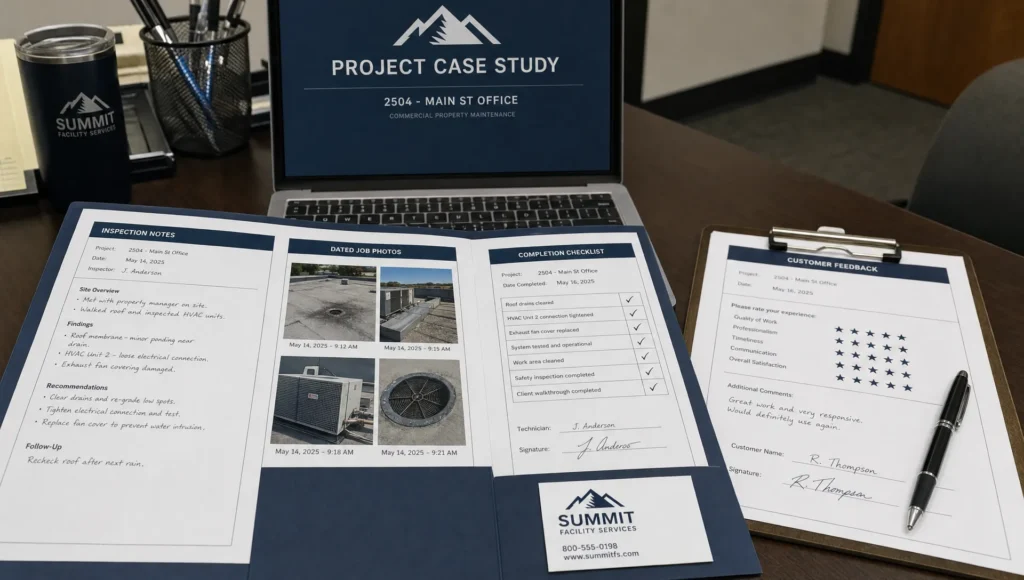
For a service business case study to be convincing, readers need a clear starting point. That could be inspection notes, dated photos, a customer’s documented complaint or an existing count of qualified inquiries.
Separate what the customer reported from what you confirmed. “The customer reported uneven heating” is different from claiming you measured a temperature difference when no measurement exists.
3. The scope of work and your reasoning
Explain what you actually did and why it fit the problem. Customers do not need every technical detail, but they should understand the decisions behind the work.
A contractor might explain why a repair was appropriate instead of a full replacement. A driving school might describe how lesson priorities were selected after an initial assessment. A website project might cover clearer service pages, simpler contact options and mobile usability fixes.
Include the relevant timeframe and any meaningful exclusions. If the job covered one room rather than an entire property, say so. If the project improved a website but did not include advertising, do not imply that it did.
4. Results supported by records
The results section should answer two questions: what changed, and what evidence supports that statement?
Not every outcome needs a percentage. A completed inspection checklist, a resolved fault or an approved handover can be stronger evidence than an unsupported claim about customer satisfaction.
Match the measurement to the job:
| Service type |
Useful evidence |
Important context |
| HVAC or plumbing |
Diagnostic findings, completed repair and follow-up check |
What was tested and when |
| Cleaning |
Agreed checklist, completion photos and customer sign-off |
Areas covered and anything excluded |
| Driving instruction |
Lesson records and documented progress against agreed skills |
Number of lessons and assessment method |
| Website optimization |
Qualified inquiries, booked consultations and conversion rate |
Tracking source, comparison period and traffic changes |
For a service business case study involving lead generation, report qualified inquiries rather than treating every form submission as a potential customer. Exclude spam and duplicates where your records allow.
If call tracking began after the work, acknowledge that you lack a comparable baseline. Better evidence does not mean pretending your records are more complete than they are.
5. A genuine customer quote
A useful quote explains something the numbers cannot: whether communication was clear, disruption was manageable or the customer understood the next steps.
Ask an open question such as, “What part of the service was most helpful?” Avoid writing praise for the customer and asking them to approve it as though those were their original words.
A testimonial and a case study do different jobs. Sites such as Cavalcade use customer testimonials as quick trust signals; your case study should add the problem, the work and the evidence behind the endorsement.
Get permission before publishing a quote, name or photo. If you edit a testimonial for length, preserve its meaning and have the customer approve the published version.
6. Constraints and limits on the result
Include circumstances that materially affected the project. Access restrictions, weather, an existing system’s condition or a limited budget can explain why you chose a particular approach.
For marketing results, distinguish the work you performed from other changes happening at the same time. More inquiries may also reflect seasonal demand, increased advertising or expanded opening hours.
You can accurately describe an improvement without claiming your work caused all of it. A short qualification makes the account more useful to someone deciding what to expect from a similar project.
7. Relevant visuals and supporting evidence
Use photos, screenshots or documents that help readers understand the work. An attractive finished photo is useful, but it should not be the only evidence on the page.
Caption each visual with what it shows. For comparison photos, identify the relevant change and use similar viewpoints where practical. Remove private information from documents and screenshots before publishing them.
If the work is highly visual, these principles for before-and-after project pages that win local leads can help you present the evidence clearly. The written explanation should still cover scope, decisions and results that photos cannot establish.
8. One clear next step
Finish by connecting the project to a service the reader can request. “Request an assessment for a similar issue” is more useful than a vague invitation to learn more.
Match the action to how your business actually works. That might be calling to discuss a repair, requesting an estimate or checking lesson availability. Do not promise instant appointments or response times unless you can consistently provide them.
Place the contact option where it is easy to find on a phone. Proof loses value if the visitor cannot work out how to reach you.

Use a simple writing template
You do not need a long interview or a polished sales narrative to get started. Build the first draft from job records, then check anything that relies on memory.
Use this fill-in structure for your service business case study:
Customer and location: [Customer type] in [relevant service area] needed help with [specific issue]. Keep identifying details within the customer’s permission.
Starting situation: Before the work, [documented condition] was causing [practical consequence]. We confirmed this through [inspection, records or assessment].
Work completed: We carried out [defined scope] over [timeframe]. We chose this approach because [reason relevant to the customer’s problem].
Verified outcome: After completion, [documented result]. This was checked using [evidence or measurement method]. [Any important limitation] still applied.
Customer perspective and next step: Add an approved quote if available, then invite readers with a similar need to [appropriate contact action].
Replace every placeholder with verified information. If a section has no reliable answer, collect the missing detail or omit the claim.
Make the page useful for local search
A case study can support local SEO by documenting real work in a place you serve. Its first job, however, is helping a customer evaluate your business, not repeating a city name.
Use a descriptive page title that combines the service, location and main problem when those details are relevant and approved for publication. A format such as “Boiler Repair in [Neighborhood]: Diagnosing a Recurring Shutdown” tells readers more than “Another Happy Customer.”
Within the page, link naturally to the service described. From that service page, link back to the case study as supporting evidence. This gives visitors a useful path between what you offer and an example of your work.
Keep location details accurate. One completed project does not justify claiming a staffed office in that neighborhood. Businesses that travel to customers can build visibility through service-area SEO without a public office.
Publishing a case study does not guarantee higher Google Maps rankings. Treat it as part of a clear, trustworthy website that supports your local presence and helps visitors decide to contact you.
Use AI to organize the draft, not create the evidence
AI can turn approved notes into an outline, identify missing information or simplify technical language. It can also help prepare follow-up interview questions before you contact the customer.
Give it boundaries: use only the supplied facts, flag missing details and do not generate quotes or results. Remove names, addresses and confidential records before entering information into a tool unless you have appropriate authorization and safeguards.
Compare the draft against the original records before publishing. AI-assisted editing can save time, but responsibility for every claim stays with your business.
Frequently asked questions
How long should a service business case study be? A straightforward project may need only 500 to 900 words, while a complex engagement may need more. Use enough space to explain the problem, scope and evidence without repeating the same result in several sections.
Can I publish a case study without naming the customer? Yes. Describe the customer type and relevant situation without identifying them. Confirm permissions for any quotes, photos or details that could still reveal who they are.
What if I do not have numerical results? Use other verifiable evidence, such as inspection records, completed checklists, documented milestones or approved customer feedback. Do not invent percentages to make the project sound stronger.
Should I include pricing? Include it when you have permission and it helps explain the scope. Clarify what the amount covered and that a different job may require a different estimate.
Make your proof easier to find and act on
A strong case study gives visitors a reason to trust you. A clear, mobile-friendly website makes it easier for them to take the next step.
Sleek Web Designs helps service businesses improve website clarity, local visibility and lead-generation paths through website optimization and local SEO, with no long-term contracts. If your website gets attention but too few inquiries, talk with Sleek Web Designs about finding and fixing the gaps.