
Most local service websites don’t have a traffic problem, they have a homepage copy problem.
People land on your site from Google Maps, a referral, or a quick search like “plumber near me.” They’re not there to admire your logo. They’re there to answer three questions fast:
- Do you do what I need?
- Do you serve my area?
- Can I trust you enough to call right now?
If your homepage doesn’t answer those clearly (in plain English), you lose the call.
What “good” homepage copy actually does for a local service business
Your homepage has one job: turn a visitor into a lead (usually a call, sometimes a form submission).
That means your copy must:
- Match intent (they want a solution now, not your company history)
- Reduce uncertainty (pricing approach, availability, credentials, what happens next)
- Prove you’re local and legit (service area, reviews, photos, licenses, real business details)
- Make the next step obvious (one primary call to action, repeated at the right spots)
A homepage that “looks nice” but doesn’t do the above is not a business asset. It’s a digital brochure.
The #1 mistake: writing about yourself instead of the customer
A lot of homepages open with something like:
“Welcome to ABC Services. We are dedicated to excellence and customer satisfaction…”
That copy is about you. The visitor is thinking about their flooded basement, broken AC, or a move-out cleaning.
A better opening starts with the outcome they want, in the area you serve, with a clear next step.
A simple rule that keeps your homepage focused
Lead with the problem you solve, not your business name.
Your logo already says your name. Your headline should say why someone should call.
A homepage copy framework that consistently gets more calls
You don’t need clever writing. You need clear blocks of information, in the right order.
Here’s a practical structure we use for local service sites.
1) Above the fold: say what you do, where you do it, and what to do next
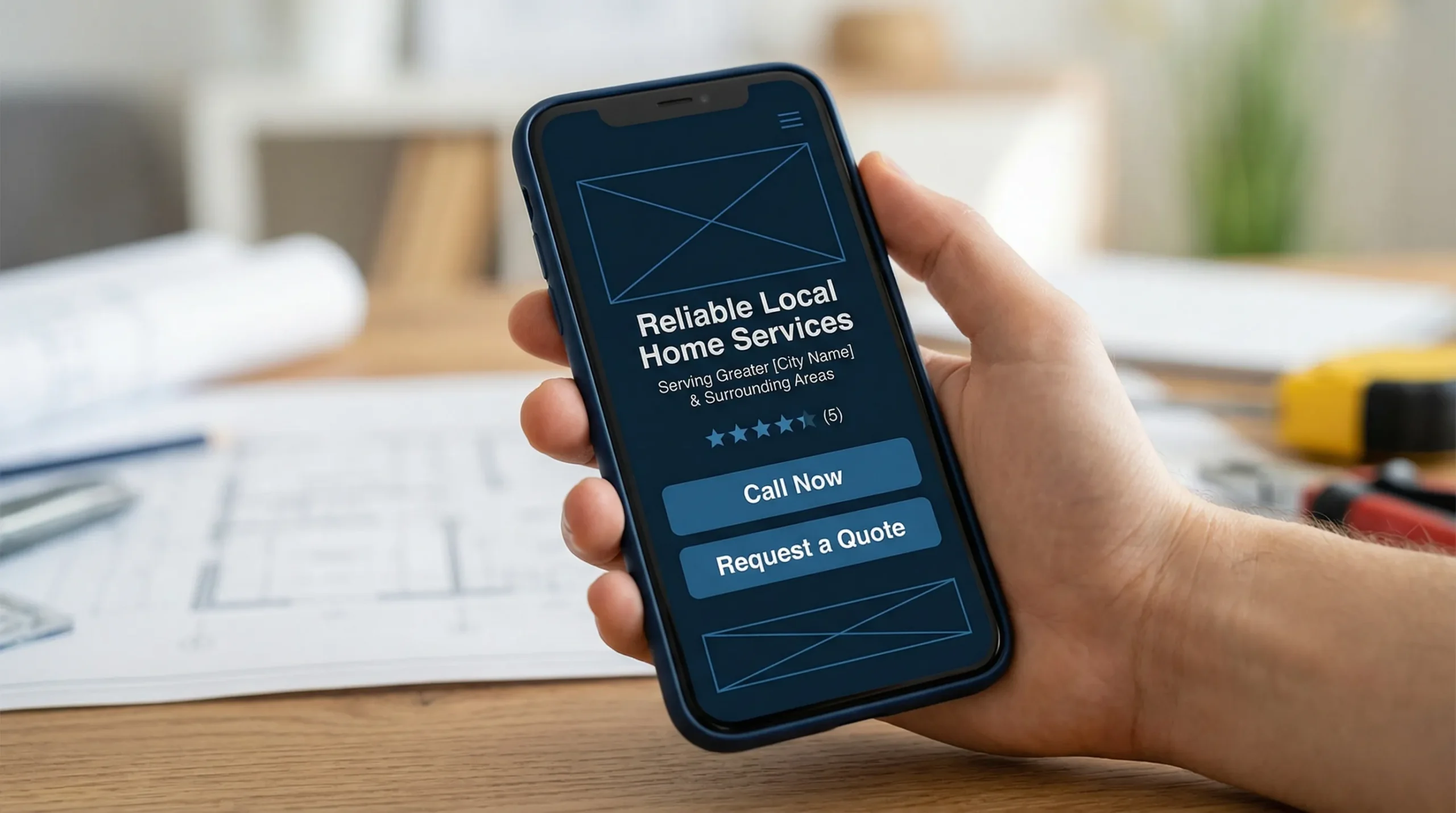
Your hero section should include:
- A headline that states the service and outcome
- A subheadline that removes a common doubt (availability, speed, estimate type)
- A primary CTA (usually “Call Now” or “Get a Quote”)
- A local signal (service area, neighborhood, city)
Copy template (fill in the blanks):
[Primary service] in [city/area], done right the first time.
Fast scheduling, clear communication, and quality work you can count on.
Call [phone] or request a quote.
Example (HVAC):
AC Repair in Brooklyn, with fast scheduling.
Tell us what’s happening, we’ll confirm availability and next steps.
Call now to book service.
Keep it specific. Keep it readable on a phone.
2) Proof bar: give quick reasons to trust you (without a novel)
Right under the hero, add a short “proof bar.” This is not the place for paragraphs.
Use 3 to 5 quick trust signals that are true for your business, such as:
- Licensed and insured (if applicable)
- Same-day or next-day availability (only if you can deliver)
- Real review count and rating (if strong)
- Warranty or guarantee language (only if you actually offer it)
- Years in business (if meaningful)
If you don’t have strong proof yet, don’t fake it. Use clarity instead: “Family-owned,” “Upfront estimates,” “Text updates,” “No surprise add-ons” (again, only if true).
3) Services: help them self-qualify in 5 seconds
Your homepage should make it easy to confirm: “Yes, they do my exact thing.”
Instead of a vague paragraph about “full service solutions,” list your core services.
Good service blocks include:
- The service name in plain language
- A one-line description focused on the result
- A link to a dedicated service page (important for SEO and conversions)
Example:
- Drain cleaning: clear the clog, identify the cause, and prevent repeat backups
- Water heater repair: restore hot water and confirm safe operation
- Leak detection: find the leak fast and explain repair options
4) “How it works”: reduce friction with a simple process
People call businesses that feel easy to deal with.
Add a short section that explains what happens after they reach out. Keep it honest and simple.
Here’s a clean format:
| Step | What the customer does | What you do | Why it helps you get calls |
|---|---|---|---|
| Contact | Call or request a quote | Confirm details and availability | Reduces uncertainty |
| Schedule | Pick a time | Show up and assess the issue | Shows you’re organized |
| Complete | Approve work | Finish the job and explain next steps | Builds trust and closes |
No fluff. Just the process.
5) “Why choose us”: real differentiators (not generic claims)
Avoid filler like “high quality” and “great customer service.” Every business says that.
Instead, write differentiators that are concrete. Good examples:
- “You get a written scope of work before we start.”
- “We work in [neighborhoods/areas], so scheduling is faster.”
- “We send a confirmation text when the tech is on the way.”
- “We clean up the work area before we leave.”
If you can’t explain it in one sentence, it’s probably not a differentiator.
6) Reviews and local proof: show you’re a real business in a real area
For local services, trust is the conversion lever.
Include:
- A short review snippet section (Google reviews are usually best for local trust)
- Photos of your team, trucks, projects, or completed work (real photos beat stock)
- A quick “areas served” section
Also make sure your name, address, and phone number are consistent with your Google Business Profile.
If you want to go deeper on local visibility, this ties directly into your map rankings and conversions. A strong homepage supports your broader local SEO foundation (and your service pages do the heavy lifting for specific searches).
What strong homepage copy looks like (side-by-side)
Here’s a quick way to spot weak copy.
| Goal | Weak copy | Strong copy |
|---|---|---|
| Clarify service | “We offer solutions for your needs.” | “24/7 emergency plumbing repairs in Brooklyn.” |
| Build trust | “We pride ourselves on quality.” | “Licensed and insured. Clear estimates before work begins.” |
| Create action | “Contact us for more information.” | “Call now to schedule service. We’ll confirm availability.” |
| Show local relevance | “Serving the community.” | “Serving Brooklyn, Queens, and nearby areas.” |
Strong copy is not louder. It’s clearer.
Your homepage should support local SEO, not fight it
Homepage copy affects rankings indirectly and conversions directly.
A few practical SEO wins that also help calls:
Put your primary service and location in the headline (naturally)
If you’re a Brooklyn contractor, don’t hide it.
A homepage headline like “Home Renovation Done Right” is vague.
A better version:
- “Home Remodeling in Brooklyn (Kitchens, Baths, and Full Renovations)”
It reads like a human wrote it and it aligns with how people search.
Add a clean “Areas Served” section
This helps users and reinforces relevance. Keep it readable.
Good format:
- Primary city/borough
- A few nearby neighborhoods
- A note that you may serve nearby areas (without listing 40 towns)
Don’t stuff every keyword into one page
Your homepage should focus on your core services and location.
Your detailed targeting belongs on dedicated pages (one page per service is usually the cleanest path for service businesses).
If you need help aligning your pages with search intent, Sleek Web Designs covers this in our lead-focused approach to SEO and site structure (see our breakdown of SEO and web design services that turn visits into leads).
A quick lesson from a non-service business (that applies perfectly)
Want to see what clarity looks like?
Look at how a product-based business like American Bulk Pallets structures its homepage: clear categories, obvious next steps, and straightforward language about what they sell and how to buy.
Different industry, same principle: make it easy for the visitor to understand the offer and take the next step. Your local service homepage should feel just as simple.
How to use AI to improve homepage copy (without making it sound robotic)
AI can help, but only if you feed it real inputs.
Here’s the practical way to use it for homepage copy:
Use AI to extract patterns from real customer language
Collect:
- The top 10 questions people ask when they call
- The top 10 objections (price, timing, trust, warranties, “Do you service my area?”)
- The exact phrases customers use to describe the problem
Then use AI to summarize those patterns and propose headline variations.
Use AI to generate 5 headline options, then pick the clearest
You are not looking for “creative.” You’re looking for “obvious.”
Run a simple test:
- Can a stranger explain what you do in 3 seconds after reading it?
- Does it imply a reason to call now?
- Does it include a location or service area signal?
Use AI to tighten copy, not invent claims
AI is good at shortening paragraphs and removing fluff.
AI is bad at guessing facts.
Do not let it add:
- Fake review counts
- “Award-winning” claims you can’t prove
- “Same-day service” if you don’t consistently offer it
Used the right way, AI speeds up editing. It should not rewrite your business into something it’s not.
Homepage copy checklist (built for more calls)
If you want a quick self-audit, use this list. If you can’t check an item, that’s a likely leak in your lead flow.
- Your headline clearly says what you do and where you do it
- Your phone number is visible at the top on mobile
- Your primary CTA is a call (or quote request) and repeats throughout the page
- You list core services in plain language
- You show real trust signals (reviews, credentials, photos, guarantees you actually offer)
- You explain what happens after the call (short “how it works” section)
- You include a simple service area section
- Your copy avoids vague claims and focuses on outcomes
- The page is easy to scan (short blocks, clear headings)
- The site loads fast and feels clean on a phone (because most calls come from mobile)
If your homepage isn’t getting calls, it’s usually one of these 3 issues
Most underperforming homepages fail in one of these spots:
1) The offer is unclear
Visitors should not have to “figure out” what you do.
2) The page doesn’t feel trustworthy
No reviews, no photos, no specifics, and no local presence signals equals fewer calls.
3) The next step is buried
If someone has to hunt for a phone number or scroll forever to find “Contact,” you lose.
Want your homepage rewritten to generate more local leads?
If you’re a local service business and your website gets traffic but not enough calls, you don’t need a full “rebrand.” You need a homepage that does its job.
Sleek Web Designs helps small businesses turn their websites into lead-generating systems with conversion-focused web design, local SEO, and AI-assisted analysis that stays grounded in reality.
If you want, we can review your homepage and tell you exactly what’s blocking calls, what to change first, and what will move the needle, without locking you into a long-term contract. Start here: Sleek Web Designs.