The most useful local keywords often describe a need that broad service terms leave out: adult driving lessons, a leaking water heater or cleaning before a tenant moves in. Finding those searches starts with understanding what customers ask for, then checking whether competing websites answer those needs clearly. You do not need the biggest keyword list. You need a focused set of searches that could bring the right people to your business.
What makes a keyword opportunity worth pursuing?
A keyword gap is not simply a phrase missing from a competitor’s website. It is a customer need that relevant search results do not address well, and that your business can genuinely meet.
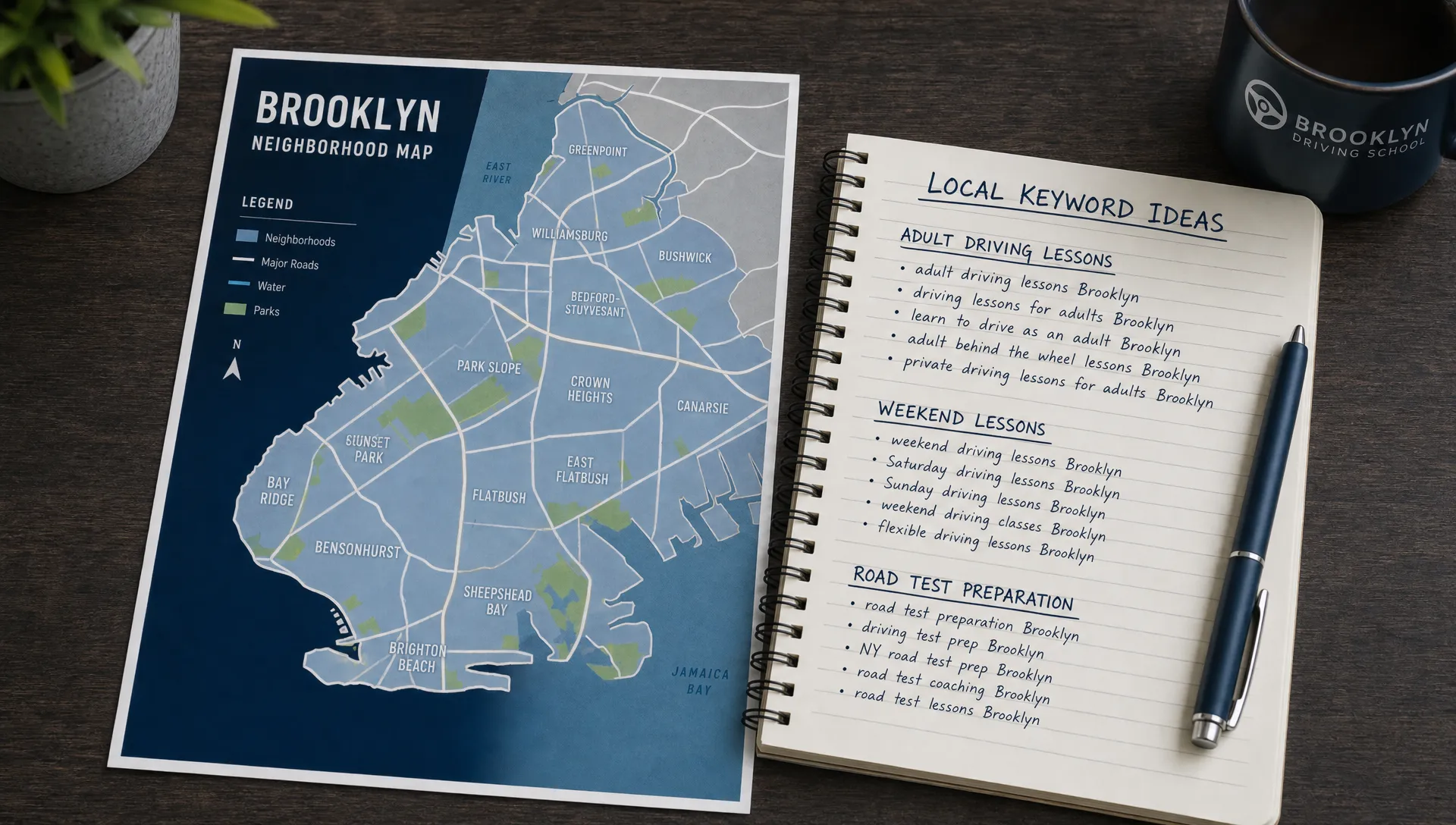
For example, a driving school might have a general lessons page without explaining whether it teaches nervous adults or offers weekend appointments. Those could be opportunities, but only if the school provides those services and there is evidence of demand.
The following are research examples, not verified search-volume or competition data:
| Potentially overlooked need |
Example search to investigate |
What the customer needs to know |
| Adult beginners |
adult driving lessons Flatbush |
Whether instruction suits someone starting later in life |
| Scheduling constraints |
weekend driving lessons Brooklyn |
Whether lessons fit their availability |
| Test preparation |
road test practice Brooklyn |
What preparation includes and who it suits |
| Language preference |
driving lessons in Spanish Brooklyn |
Whether instruction is available in that language |
A useful opportunity connects customer intent, your actual service and a weakness in the current results. A longer phrase alone does not make it valuable or easy to rank for.
Find local keywords in your own customer data
Before paying for more research tools, review the information your business already receives. It can reveal specific needs that broad keyword databases blur together.
Review calls, inquiries and booking questions
Look through recent contact forms, booking notes and questions your team hears repeatedly. Capture the customer’s wording rather than translating everything into industry language.
A plumber might describe a service as “water heater diagnostics,” while callers say “the shower has no hot water.” A driving instructor might offer refresher lessons, while customers ask for “driving lessons after not driving for years.”
Keep a simple research sheet with the phrase, service involved, location and source. Mark whether the question came from a qualified prospect, an existing customer or an unrelated inquiry.
Repeated questions from people you can actually serve deserve attention. They are stronger starting points than a large list of loosely related terms.
Look for overlooked queries in Google Search Console
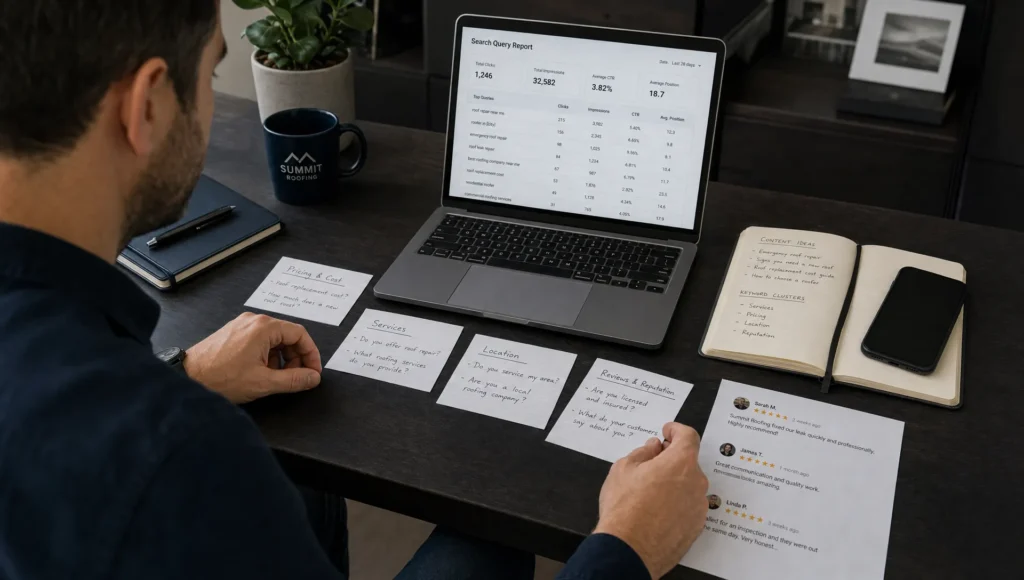
Open the Performance report in Google Search Console and review search queries for your important service pages. Google’s Performance report documentation explains how queries, pages and filters work.
Look for searches that receive impressions but seem poorly matched to the page appearing in results. For example, your general driving lessons page might appear for adult beginner searches even though its copy focuses on teenage students.
Investigate modifiers related to neighborhoods, customer types, problems and appointment timing. Compare a longer period with a recent period so one unusual week does not drive your decisions.
These local keywords are promising research leads, not automatic winners. Low clicks can reflect weak relevance, a low ranking or limited demand. Search Console also does not display every query, so an absent phrase is not proof that nobody searches for it.
Use reviews and suggestions as supporting evidence
Read your own reviews and public reviews of nearby competitors. Customers often mention details that service pages overlook: patience with beginners, help with an older home or availability after work.
Google autocomplete and related searches can supply additional wording to investigate. Record relevant suggestions, but do not treat them as precise measures of local demand.
If several sources point toward the same need, it becomes a stronger candidate. A review mentioning nervous adult learners, similar booking questions and related Search Console impressions together provide a useful reason to investigate further.
Check what competing search results actually miss
Your search competitors are the businesses appearing for a particular query, not necessarily the companies you know locally. Results can change by location and device, so record where and how you checked them.
Search a small batch of candidate phrases and review both the local map results and organic listings. Do not assume a phrase is easy because only one competing page uses the exact wording. Google can match pages to related language and intent.
Look for missing answers, not missing words
Open the relevant pages from several competing businesses. Check whether a potential customer can quickly establish:
- Whether the business provides the specific service or handles the stated problem.
- Whether it serves the neighborhood or customer type involved.
- Whether timing, eligibility or service limitations are clear.
- Whether there is an obvious next step to call, request an estimate or book.
A competitor might mention “adult lessons” once without explaining its approach for beginners. Another might list a neighborhood without saying how service works there. Those are possible content gaps.
On the other hand, a detailed page that answers the need well is not a weak competitor simply because its design looks dated. Judge usefulness and relevance before aesthetics.
Record the gap beside each candidate: “No explanation for nervous beginners” is more actionable than “competitor does not use this keyword.”
Look beyond a town-name swap
Local keywords become more useful when they combine a real service need with genuine geographic coverage. Simply attaching ten neighborhood names to the same broad service gives you little insight into what customers want.
Comparable service businesses can help you think through that structure. For example, MDSI’s IT services for businesses in Réunion and Mayotte cover needs such as IT management and cybersecurity within a defined service region. The transferable lesson is to separate distinct customer needs while being clear about where you operate.
For a Brooklyn contractor, that might mean researching renovation needs for particular property types rather than building a list of borough names alone. These angles still need validation before becoming website content.
Validate demand before building a page
A competitor gap is only half the decision. You also need evidence that the search relates to work you want and can deliver.
Use a keyword tool to compare related phrases and check geographic settings carefully. Some tools provide broader regional estimates rather than reliable neighborhood-level numbers. A reported zero does not prove that a phrase has no demand, but it also does not justify creating a page without other evidence.
Assess each candidate against these four checks:
| Check |
Evidence to look for |
Reason to pause |
| Service fit |
You provide the service and can describe it accurately |
The phrase implies work you do not offer |
| Customer intent |
Results and wording suggest a relevant service inquiry |
Searchers mainly want free instructions or unrelated information |
| Demand signals |
Customer questions, impressions or relevant tool data |
The phrase exists only in an AI-generated list |
| Competitive gap |
Current pages leave an important question unanswered |
Results already address the need thoroughly |
Prioritize local keywords with several supporting signals, not just the highest estimated volume. A specific service inquiry can be worth more to your business than a broad informational search, although the outcome depends on your offer and conversion process.
Choose a small first batch you can support with accurate content. Three well-researched opportunities are more useful than thirty speculative pages.
Use AI to organize evidence, not invent demand
AI can help group a messy research sheet into themes. It is useful for sorting similar questions, identifying modifiers and suggesting which existing page might answer a need.
Give it a bounded task, such as:
Group these anonymized customer questions and search queries by service, location and customer need. Preserve the original wording. Suggest which groups could fit an existing page. Do not invent search volumes, rankings or services. Label any new keyword ideas as hypotheses.
Remove names, phone numbers, addresses and other personal information before sharing customer records with an AI tool. Review the output against your actual services and service area.
AI-generated local keywords are research suggestions, not evidence of demand. Verify new phrases through customer information, search results or reliable tool data before investing in content.
This keeps AI useful and simple: it reduces sorting work while leaving business decisions with you.
Turn keyword gaps into pages that generate inquiries
Improve an existing page when the intent is the same
Not every phrase needs a separate landing page. “Adult driving lessons” and “driving lessons for adult beginners” may belong on the same page because they describe closely related needs.
If your existing page already serves that audience, add the missing answers. Explain who the service suits, what happens next and any genuine requirements or limitations. Use the customer’s language naturally in headings and copy.
Our guide to adding keywords without making copy awkward explains how to make those edits readable.
Create a separate page when the service or customer journey is meaningfully different and you have enough useful information to support it. Avoid near-identical neighborhood pages that only change the place name.
Make the next step obvious on mobile
Once a visitor reaches the page, they should quickly understand whether you can help. Show the service area, relevant service details and a clear call or booking option.
A keyword-focused page will not generate many inquiries if the phone number is hard to find, the form is confusing or the mobile layout hides important information. Website optimization should remove those obstacles, not just change the page’s appearance.
Keep your Google Business Profile information consistent with your real services. Google states that local results depend mainly on relevance, distance and prominence. Better content can clarify relevance, but keywords do not erase distance or guarantee a map ranking. Do not add keywords to your business name unless they are genuinely part of its real-world name.
Measure whether the opportunity produces business
After updating a page, record the change date and review performance over comparable periods. Check whether relevant queries gain visibility, whether the intended page appears and whether visitors take useful actions.
Track qualified calls, estimate requests and bookings where possible. Separate genuine prospects from spam and inquiries outside your service area. More traffic is not a win if it brings the wrong customers.
Search Console does not connect an individual query to a particular phone call. Evaluate query trends alongside page-level lead data rather than claiming a precise keyword-to-sale connection you cannot verify.
If relevant impressions increase but inquiries do not, review the page’s offer, clarity and contact process. If the traffic is mostly informational, reconsider the intent you targeted.
The goal is to build a repeatable method for finding local keywords, testing them and keeping the opportunities that contribute to customer growth.
Frequently asked questions
How can I find keyword gaps without paid tools? Start with customer inquiries, Google Search Console, public reviews and manual searches. These sources can reveal needs and content gaps, though they will not provide a complete picture of search volume or competition.
Are longer local search phrases always easier to rank for? No. A longer phrase can still have strong competition or closely match a broader search. Inspect the actual results and assess whether you can provide a more useful answer.
Should I create a page for every neighborhood? No. Create a location page only when you genuinely serve the area and can provide useful, distinct information. Otherwise, a clear service-area section on a relevant service page may be sufficient.
How soon should I judge an update? Allow time for Google to crawl changes and for enough relevant data to accumulate. Low-volume local searches may take longer to evaluate. Use comparable periods and qualified inquiries rather than a fixed ranking deadline.
Find the opportunities your website is missing
If your website is getting little visibility or too few qualified inquiries, start with the gap between what customers ask and what your pages explain.
Sleek Web Designs helps service businesses improve local visibility and lead generation through website audits, conversion-focused design and practical SEO support. AI-assisted analysis helps identify what needs attention, without replacing the research. Contact us to discuss your website and local search priorities, with no long-term contracts.