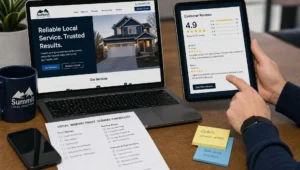
AI search results for local businesses are changing how people choose who to call. A customer may no longer scroll through ten blue links, open five tabs and compare every website by hand. They might ask Google, ChatGPT, Bing Copilot or another AI tool for “a reliable plumber near me” or “best driving school in Brooklyn,” then act on the businesses the answer makes easy to trust.
That does not mean your website is dead. It means your website, Google Business Profile, reviews and local signals need to give search engines clear proof that your business is real, relevant and worth recommending. If your online presence is thin, outdated or confusing, AI search makes that weakness more obvious.
For small businesses, the goal is not to chase every new AI feature. The goal is to become easier to find, easier to understand and easier to choose.
What AI search results for local businesses actually change
AI search results for local businesses do not replace local SEO. They raise the bar for clarity. Instead of only matching keywords on a page, AI-powered results often summarize information from multiple sources, including websites, map listings, directories, reviews and trusted local content.
A traditional search result might show your homepage, a competitor’s service page and a directory listing. An AI-style result may summarize which companies serve a specific area, what customers mention in reviews, what services appear most relevant and whether the business information looks consistent.
| Search behavior | What used to matter most | What matters more now |
|---|---|---|
| Customer searches for a service nearby | Ranking in Google Maps and organic results | Being clearly described across your site, profile and citations |
| Customer asks an AI tool for recommendations | Brand visibility and review count | Trust signals, service details, location relevance and consistency |
| Customer compares options | Website design and basic contact info | Clear answers, proof of work, reviews and fast conversion paths |
| Customer is ready to call | Phone number and contact page | Click-to-call, mobile speed, simple service pages and strong local proof |
Google’s own guidance on Search emphasizes helpful, reliable, people-first content. That still applies. The difference is that your business information may be interpreted, summarized and compared before the customer ever lands on your site.
Why some local businesses disappear from AI-driven answers
AI search results for local businesses tend to favor information that is easy to verify. If your online presence gives mixed signals, you make it harder for search systems and customers to trust you.
The most common problem is not a lack of fancy technology. It is messy basics. Your website says one thing, your Google Business Profile says another and your reviews mention services your website never explains. Maybe your service area is buried in a paragraph. Maybe your phone number appears differently across directories. Maybe your homepage says “quality service” ten times but never clearly explains who you help.
AI tools are not magic detectives. They work with the information available to them. If that information is vague, inconsistent or outdated, your business may be skipped in favor of a competitor with a cleaner online footprint.
For a service business, visibility usually comes down to three questions:
- Can search engines understand what you do?
- Can they understand where you do it?
- Can they find proof that customers trust you?
If the answer to any of those is weak, your visibility can suffer in both regular search and AI-powered search.
Build a website AI can understand and customers can act on
A good local business website does not need to be complicated. It needs to explain your services, location, credibility and next step without making visitors work. That also helps AI search results for local businesses because clear pages are easier to interpret.
Start with service pages that answer the same questions a real customer would ask before calling. If you are a contractor, explain the specific service, common problems you solve, towns or neighborhoods served and what the customer should expect next. If you run a driving school, explain lesson types, road test support, service areas and booking options.
Do not rely on one general “Services” page if you offer several important services. A plumbing company should not bury water heater repair, drain cleaning and emergency plumbing in one short paragraph. Each core service deserves enough detail to stand on its own.
Your website should also make contact simple. Phone numbers should be visible on mobile. Forms should be short. Calls to action should be direct, such as “Call for an estimate” or “Request service.” A beautiful website that does not generate calls is not doing its job.
If your current site looks fine but does not bring in leads, the issue may be structure, clarity or search visibility. Sleek Web Designs focuses on custom website design and optimization built around calls, leads and local growth, not just visuals.
Strengthen your Google Business Profile before chasing AI tricks
Your Google Business Profile is still one of the strongest local visibility assets you have. It feeds Google Maps, local results and the information customers see when they search for your business name. It can also support how your business is understood in AI-influenced search experiences.
Make sure the basics are complete and accurate: business name, primary category, services, service areas, hours, phone number, website link and photos. Your category matters because it tells Google what type of business you are. Your services matter because they help connect you to specific customer intent.
Reviews also carry weight. Not just star ratings, but the language customers use. A review that says “fast emergency AC repair in Bay Ridge” is more useful than “great company.” You cannot script reviews, but you can ask happy customers to mention the service they received and the area where you helped them.
For a more detailed walkthrough, this guide to Google Maps optimization for higher local rankings covers the profile improvements that still matter in 2026.
Make your business information consistent everywhere
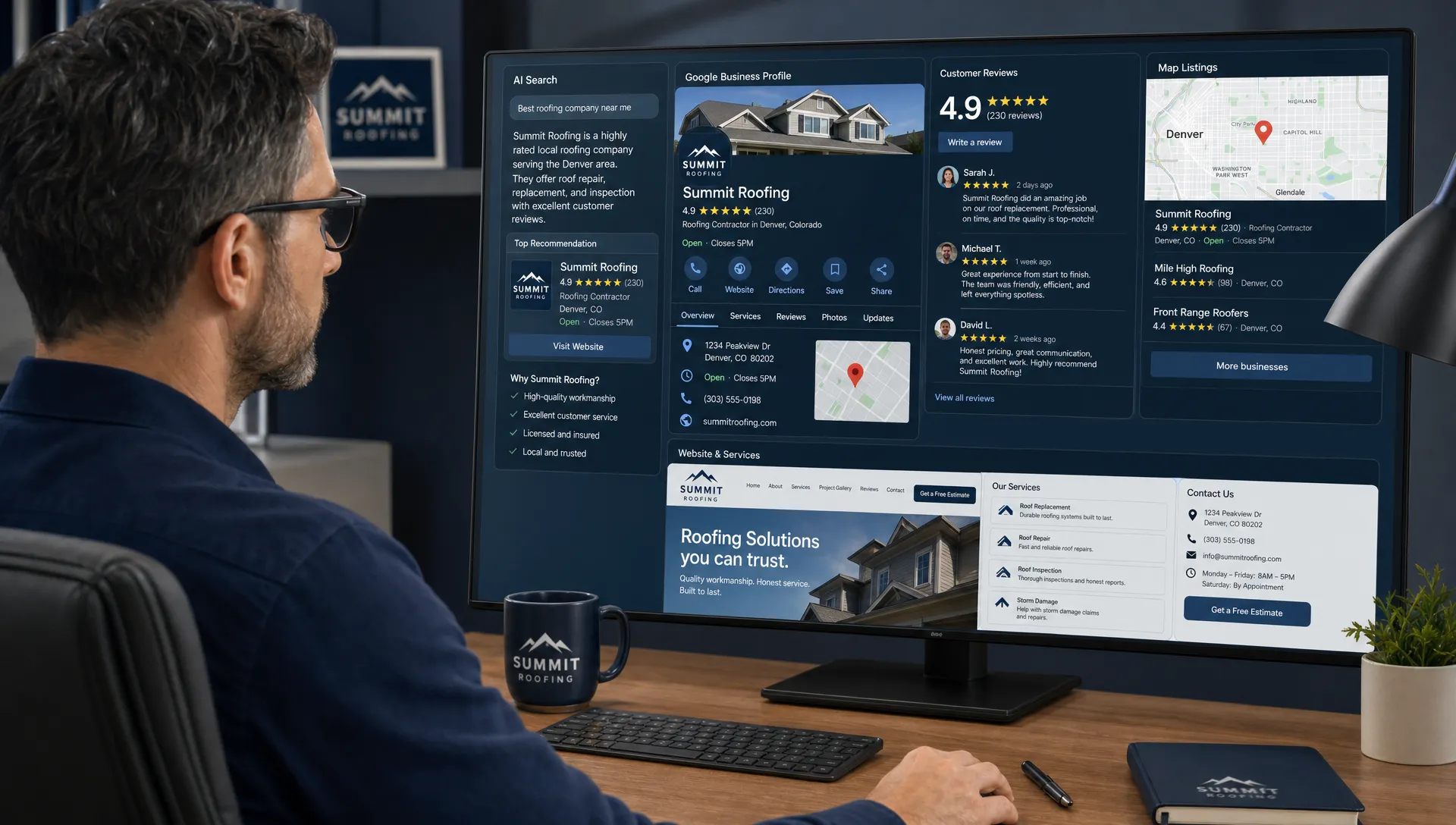
AI search results for local businesses depend heavily on confidence. Consistent information builds confidence. Conflicting information creates doubt.
Your business name, address, phone number and website should match across major listings, local directories, industry directories and social profiles. If you are a service area business without a public storefront, your setup needs to be even cleaner. Do not create fake office addresses or duplicate listings just to appear in more towns. That can hurt trust and create long-term cleanup problems.
Citations are not glamorous, but they support your local footprint. The goal is not to be listed on every directory on the internet. The goal is to have accurate information on the places customers and search engines actually use.
You should also keep your service descriptions consistent. If your website calls a service “home cleaning,” your profile calls it “maid service” and your directory listing says “janitorial,” search engines may still understand it, but clarity is better. Use natural language, but avoid unnecessary variation that makes your business harder to categorize.
For businesses that serve customers at their location, this guide on service area business SEO without an office explains how to handle visibility without risking your Google profile.
Publish local content that answers real buying questions
You do not need to publish endless blog posts to stay visible. You need content that helps a local customer decide whether to call you. AI search results for local businesses are more likely to surface clear, specific answers than generic marketing copy.
Good local content usually comes from real customer questions. For a roofer, that might include storm damage repair, roof replacement timelines or what to do after a leak. For a driving school, it might include road test preparation, lesson packages, permit requirements and local DMV testing concerns. For a cleaning company, it might include move-out cleaning, recurring service, apartment cleaning or office cleaning in specific neighborhoods.
The best pages are practical. They explain the problem, show how your business helps and make the next step obvious. Avoid writing thin posts that only repeat “best service near me.” That may have worked years ago, but it does not build trust now.
A simple content plan can cover:
- Core service pages for each high-value service
- Location pages for real service areas where you can take customers
- FAQ sections based on actual phone calls and emails
- Case-style pages showing problems solved, without exaggeration
- Review-driven updates that reflect what customers consistently praise
This supports both local SEO and AI visibility because it gives search systems more useful context about your work.
Add structured data, but do not treat it like a shortcut
Schema markup can help search engines understand your business type, services, address, hours, reviews and page content. It is useful, especially for local businesses, but it does not fix weak content or poor service pages.
Think of structured data as labeling. If your page already explains your HVAC repair service clearly, local business schema can reinforce the details. If the page is vague, schema simply labels a weak page.
Common schema types for local businesses include LocalBusiness, Service, FAQPage and Review where appropriate. Implementation should be accurate. Do not mark up fake reviews, misleading ratings or services you do not actually provide.
Many small business owners do not need to manage schema themselves. They need a website setup where these technical details are handled correctly, then checked over time. That is where a practical SEO agency or website optimization partner can save time.
Use AI to audit, not to replace your local strategy
AI can be useful, but not when it turns your marketing into generic filler. The smartest use of AI search results for local businesses is to identify gaps, compare visibility and improve clarity.
For example, AI tools can help summarize your service pages, scan competitor pages, find missing customer questions and identify inconsistent messaging. They can also help turn messy notes from your team into a better FAQ or service description. That saves time.
What AI should not do is invent claims, write fake local stories or create pages for towns you do not serve. Customers can spot empty content, and search engines are getting better at ignoring it.
Use AI as a helper, not the driver. Your real advantage comes from your actual services, real customer feedback, local experience and a website that turns interest into calls.
At Sleek Web Designs, AI-assisted website and SEO analysis is used in a practical way: to find what is holding a site back, improve the right pages and support better local visibility without overcomplicating the process.
Track the signals that lead to calls, not vanity metrics
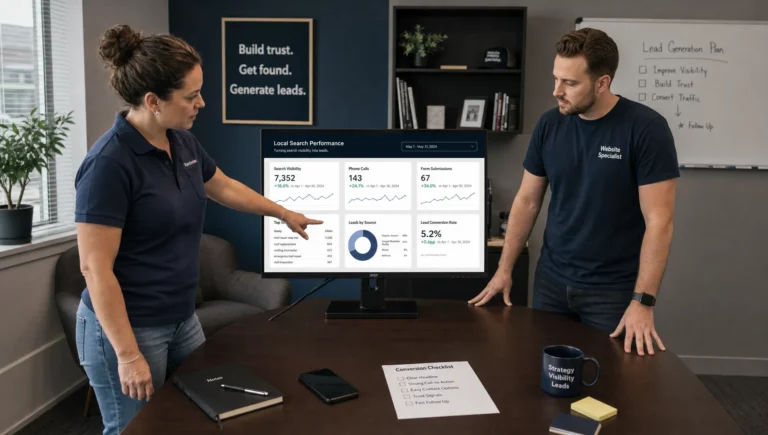
Ranking reports are useful, but they are not the whole story. A local business owner needs to know whether search visibility is turning into phone calls, form submissions, bookings and real customers.
When measuring performance, focus on outcomes that connect to revenue. Search impressions can be helpful, but a rise in impressions means little if no one calls. Traffic can look good in a report, but low-quality traffic will not fill your schedule.
| Metric | Why it matters | What to improve if it is weak |
|---|---|---|
| Calls from Google Business Profile | Shows direct local demand | Profile categories, reviews, photos and service details |
| Form submissions | Shows website conversion strength | Page clarity, contact forms and calls to action |
| Rankings for service searches | Shows local visibility | Service pages, internal linking, content depth and authority |
| Direction requests | Useful for storefront businesses | Map accuracy, photos, hours and review strength |
| Lead quality | Shows whether the right customers are finding you | Service positioning, location targeting and page messaging |
If you want a deeper look at what influences local visibility, this breakdown of local search ranking signals is a useful next step.
A simple 30-day plan to improve AI and local search visibility
You do not need a six-month strategy document to start. You need to clean up the pieces customers and search engines rely on most.
| Timeline | Action | Business outcome |
|---|---|---|
| Week 1 | Review your website, Google profile and top directory listings for accuracy | Reduces confusion and builds trust |
| Week 2 | Improve your main service pages with clearer descriptions, service areas and calls to action | Helps customers understand why they should call |
| Week 3 | Ask recent happy customers for honest reviews that mention the service provided | Strengthens proof and local relevance |
| Week 4 | Add or improve FAQ content based on real customer questions | Helps search engines and buyers understand your business faster |
After that, review performance monthly. Look at calls, form submissions, map visibility and the pages bringing in leads. Small improvements compound when they are tied to real customer behavior.
Mistakes that make your business harder to recommend
Many local businesses lose visibility because they try to game search instead of improving trust. AI search results for local businesses make weak shortcuts even less useful.
Avoid creating dozens of thin location pages that say the same thing with a different town name. Avoid using fake addresses. Avoid buying low-quality directory links. Avoid publishing AI-written content that sounds polished but says nothing. These tactics waste time and can make your brand look less credible.
Also avoid redesigning your website only for appearance. A cleaner design is good, but not if it hides your phone number, slows down the site or removes useful service information. Web design should support lead generation. If it does not make customers more likely to call, book or request help, it is decoration.
The businesses that win are usually not the ones doing the most complicated marketing. They are the ones with clear service pages, accurate local listings, strong reviews, fast mobile pages and a simple path to contact.
Frequently Asked Questions
Will AI search replace Google Maps for local businesses? No. Google Maps and Google Business Profile visibility still matter. AI search may change how recommendations are presented, but map data, reviews, categories and local relevance remain important signals.
Do I need to rewrite my whole website for AI search? Usually not. Start by improving your most important service pages, contact paths, FAQs, reviews and local information. A full website redesign only makes sense if your current site is slow, unclear or not generating leads.
Can AI-written content help my local SEO? It can help with drafts and organization, but it should not replace real business knowledge. The content still needs accurate service details, local context, customer questions and a clear reason to contact your business.
What is the fastest way to improve local visibility? Fix your Google Business Profile, clean up inconsistent business listings, strengthen service pages and ask satisfied customers for honest reviews. These actions help both traditional search and AI-influenced results.
Do WordPress websites work well for local businesses? Yes, when they are built correctly. A WordPress site can support strong local SEO, fast pages and clear service content, but the platform alone does not create leads. Structure, content and conversion paths matter more.
Stay visible where customers are searching next
AI is changing search, but the fundamentals are still practical: be clear, be consistent and make it easy for customers to choose you. If your website is outdated, your Google profile is incomplete or your service pages do not explain what you do, those gaps can cost you calls.
Sleek Web Designs helps small businesses improve websites, local SEO and AI-assisted visibility with a focus on leads, not vanity metrics. There are no long-term contracts, and the work is built around fixing what matters first.
If you want your website and local presence to bring in more customers, contact Sleek Web Designs and start with a practical review of what is holding your visibility back.