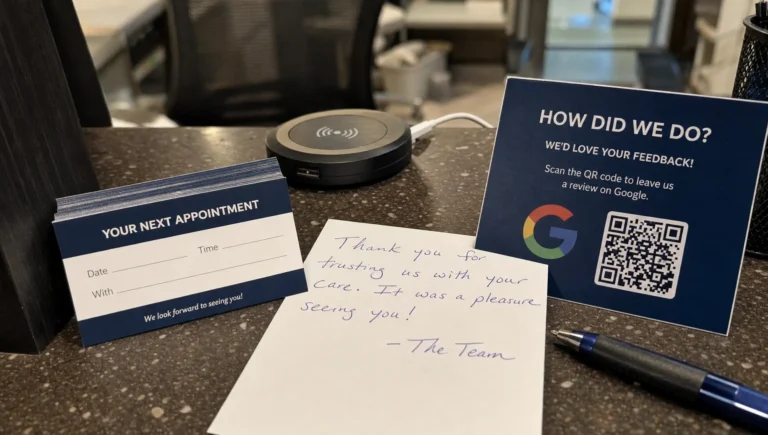
Most happy customers are willing to help your business, but most will not leave a review unless you make the next step clear. The goal is to ask for Google reviews without sounding pushy by choosing the right moment, keeping the request simple and giving the customer an easy way to say yes.
For local service businesses, reviews are not just about looking good online. They help people choose you when they are comparing options on Google Maps, reading your profile or deciding whether to call. A steady review process can support local SEO, build trust and turn finished jobs into future leads.
Why Google reviews matter for local leads
When someone searches for a plumber, driving school, cleaning company, contractor or other local service, they usually scan three things before making a decision: location, rating and recent customer comments. Your website still matters, but your Google Business Profile often gets seen first.
That is why reviews should be treated as part of your lead generation system, not an afterthought. A business with fresh, specific reviews looks active and trustworthy. A business with old reviews, vague comments or no responses can lose calls before a potential customer ever visits the website.
Reviews also support your overall Google Maps presence. They are not the only ranking factor, but they help Google and customers understand what your business does, where you serve customers and whether people trust you. If your larger goal is to get more calls from Google Maps without ads, review collection should be part of the plan.
How to ask for Google reviews without sounding pushy
The easiest way to ask for Google reviews without sounding pushy is to make the request feel like a natural close to a good customer experience. You are not begging for praise. You are giving a satisfied customer a simple way to share what went well.
A good review request has four parts: it is timely, specific, short and easy to act on. The customer should know why you are asking, what to do and how long it will take.
| Pushy request | Better request |
|---|---|
| “Can you please leave us a five-star review?” | “If you were happy with the service today, a quick Google review would really help local customers find us.” |
| “We need more reviews, so please post one.” | “Your feedback helps people in the area know what to expect before they call.” |
| “I’ll send you a few reminders until you do it.” | “I’ll send the link in case it’s convenient. No pressure at all.” |
| “Mention my name and say we were perfect.” | “A sentence or two about your experience is more than enough.” |
The better version respects the customer. It does not demand a rating, write the review for them or make the customer feel responsible for your marketing.
Ask at the right moment
Timing matters more than the exact words. If you ask too early, the customer has not experienced enough value. If you ask too late, the moment has passed and the review becomes one more forgotten task.
For most local service businesses, the best time is right after a positive outcome. That might be when the repair is complete, the home is cleaned, the student passes a road test or the client thanks you for solving the problem.
| Business type | Best time to ask | Why it works |
|---|---|---|
| HVAC, plumbing or electrical | After the issue is fixed and the customer confirms everything works | The relief is fresh and the value is obvious |
| Cleaning company | After a walkthrough or positive text about the job | The customer can connect the review to a visible result |
| Contractor or home service provider | At project completion or after final approval | The customer has seen the full outcome |
| Driving school | After a student passes or completes lessons confidently | The customer has a clear success story |
| Nonprofit or local organization | After a successful event, donation experience or service interaction | The person understands the impact of the work |
Do not ask during a complaint, before the work is complete or while the customer is still deciding whether they are satisfied. A bad moment can make even a polite request feel annoying.
Make the review process easy
Google says businesses can ask customers for reviews and share a review link. That link is important because most people will not search for your business, find the review button and write feedback on their own.
Your job is to remove friction. Send the direct review link by text, email or invoice follow-up. If you talk to customers in person, tell them you will send the link so they do not have to look anything up.
A simple review request should include:
- A short thank-you
- A direct Google review link
- One sentence explaining why it helps
- A no-pressure tone
- No request for a specific star rating
Avoid long messages. Customers are busy, and a three-paragraph review request usually gets ignored. One clear message is better than a polished speech.
Review request scripts you can use
You do not need fancy language. In fact, simple wording usually works better because it sounds like a real person. Use these scripts as a starting point, then adjust them so they fit how you normally speak.
| Situation | Use this wording |
|---|---|
| In person after a good job | “I’m glad we could get that taken care of for you. If you were happy with the service, I’ll text you our Google review link. A quick sentence or two really helps local customers find us.” |
| Text message after completion | “Hi [Name], thanks again for choosing us today. If you were happy with the service, would you mind leaving a quick Google review? It helps other local customers know what to expect: [link]” |
| Email follow-up | “Thank you for working with us. If everything went well, we would appreciate a quick Google review. Your feedback helps people in the area choose a local business they can trust: [link]” |
| Invoice or receipt message | “Happy with the service? A short Google review helps our small business get found by more local customers. You can leave one here: [link]” |
| After a compliment | “Thank you, I really appreciate that. If you’d be open to putting that in a Google review, it would help us a lot. I can send you the link.” |
The best script is the one you will actually use. If your team works in the field, keep the wording short enough to say out loud. If most communication happens by text, make the message easy to send from a phone.
What not to do when asking for reviews
Bad review requests usually fail for one of two reasons. They either pressure the customer too much or they violate platform rules.
Google’s review policies are clear that reviews should reflect real experiences. Businesses should not offer incentives in exchange for reviews, post fake reviews or manipulate feedback. You can read Google’s policy on fake engagement and prohibited review practices for the details.
Avoid these mistakes:
- Do not offer discounts, gifts or cash for reviews
- Do not ask only happy customers while blocking unhappy customers from reviewing
- Do not tell customers what rating to leave
- Do not write the review for them
- Do not send repeated reminders that feel like pressure
- Do not argue with customers in public review responses
One follow-up is fine. Five follow-ups are not. The goal is to build a steady review habit, not chase every customer until they give in.
Build review requests into your normal process
If you only ask for reviews when business is slow, the process will feel awkward. A better approach is to make review requests part of your standard customer workflow.
For example, a service business can ask at job completion, then send a text with the link the same day. A driving school can ask after a successful milestone. A cleaning company can ask after the customer confirms the job looks good. This keeps the request tied to a real experience.
Your Google Business Profile should also be set up properly before you start asking for more reviews. Make sure your business name, categories, service areas, hours, photos and website link are accurate. If those basics are weak, use a practical Google Business Profile optimization checklist before pushing harder for reviews.
A simple internal process might look like this:
- Confirm the customer is satisfied
- Ask politely in person or by phone
- Send the direct review link by text or email
- Follow up once if appropriate
- Reply to the review when it comes in
That last step matters. A short response shows future customers that you are active and paying attention. It also turns the review page into a better sales asset.
Use AI to improve the message, not fake the review
AI can help small businesses save time with review management, but it should be used carefully. The practical use is not generating fake reviews or telling customers what to say. That creates trust problems and can violate platform rules.
A better use is to draft cleaner request messages, organize feedback themes and spot common customer questions. For example, you can ask an AI tool to make your review request shorter, friendlier or better suited for text messages. You can also review patterns in customer comments to see what people praise most, such as response time, professionalism, pricing clarity or cleanup after the job.
That information can improve your website copy, service pages and local SEO strategy. If customers keep mentioning “same-day repair” or “patient driving instructor,” those are real trust signals your business can use in honest marketing.
Keep the human part human. The customer should write the review in their own words. Your role is to make the request easy and respectful.
How to handle customers who do not leave reviews
Some customers will love your service and still never leave a review. That is normal. People get busy, lose the link or simply do not write online feedback. Do not take it personally.
If a customer does not respond, send one polite reminder a few days later. Keep it short:
“Hi [Name], just following up in case the review link got buried. If you have a minute, your feedback would really help our small business. No pressure either way: [link]”
After that, move on. A healthy review strategy depends on consistency across many customers, not forcing one person to respond.
If you are getting fewer reviews than expected, look at the basics. Are your technicians or staff actually asking? Is the link direct? Is the message too long? Are you waiting too many days? Small changes can make a big difference.
What if you get a negative review?
Negative reviews happen, even to good businesses. The worst response is panic. The second worst response is arguing in public.
Reply calmly, acknowledge the concern and move the conversation offline when needed. A professional response can reduce the damage and show future customers that you take service seriously. If the review is fake, spammy or violates Google policy, you can report it, but removal is not guaranteed.
Business owners sometimes ask whether they can avoid the problem by turning reviews off entirely. In most cases, you cannot simply turn off Google reviews, so the better strategy is to build a stronger reputation with steady positive feedback and professional responses.
A few negative reviews will not ruin a business if they are surrounded by recent, credible reviews from real customers.
Connect reviews to your website and local SEO
Reviews help people trust you, but they work best when the rest of your online presence supports the same message. If your Google profile has strong reviews but your website is slow, confusing or unclear, some leads will still drop off.
Your website should make it easy for visitors to understand what you do, where you work and how to contact you. Clear service pages, visible phone numbers, mobile-friendly design and strong local content all support the trust your reviews create.
That is where good web design and local SEO overlap. The point is not to have a prettier website for the sake of it. The point is to turn visibility into calls, form submissions and booked jobs. Reviews get attention. Your website should help convert that attention into action.
For many small businesses, the winning system is simple: an optimized Google Business Profile, a clear website, consistent reviews and a follow-up process that does not rely on memory.
Frequently Asked Questions
Is it okay to ask customers for Google reviews? Yes. Google allows businesses to ask customers for reviews and share a review link. The request should be honest, no-pressure and based on a real customer experience.
Can I ask customers for a five-star review? It is better not to ask for a specific rating. Ask for honest feedback instead. A natural review is more trustworthy and keeps your request from sounding pushy.
Should I offer a discount for a review? No. Offering discounts, gifts or other incentives in exchange for reviews can violate Google’s policies and weaken trust with customers.
How many times should I follow up for a review? One polite follow-up is usually enough. If the customer still does not respond, move on and keep your review process consistent with future customers.
What is the best way to send a Google review request? Text message usually works well for local service businesses because customers see it quickly. Email can also work, especially for longer projects or professional services. The direct review link matters more than the channel.
Need more local leads from Google?
Asking for reviews is one part of getting found online. If your website, Google Business Profile or local SEO setup is weak, good reviews may not turn into enough calls.
Sleek Web Designs helps small businesses fix what is holding back their online visibility and turn their website into a lead-generating system. We focus on practical website optimization, local SEO, AI-assisted analysis and clear strategies that help local customers find and contact you.
If you want more calls without overcomplicating your marketing, visit Sleek Web Designs. No long-term contracts, no vanity metrics, just a better system for getting found and getting leads.