
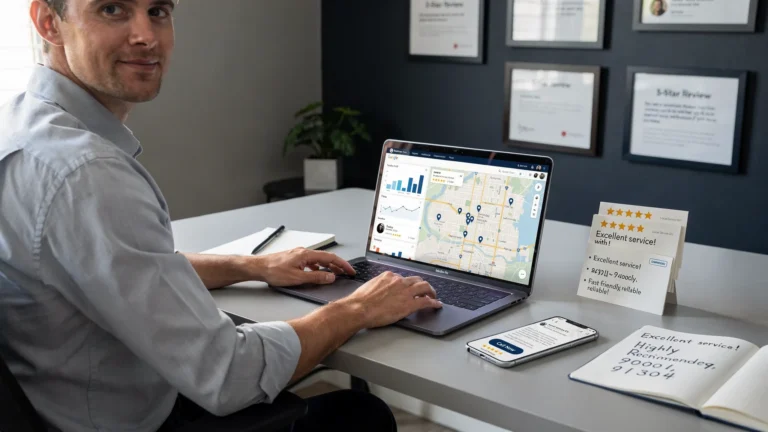
If your cleaning business shows up on Google but the phone is not ringing, you do not have a “marketing” problem. You have a local visibility and conversion problem.
Local SEO for cleaning companies is less about rankings in general and more about getting into the Map Pack, earning trust fast (reviews), and turning clicks into calls.
Below is a lead-first plan you can actually run, whether you serve one neighborhood or a whole metro area.
What “local SEO” means for a cleaning company (in plain English)
Most cleaning jobs start with intent: “house cleaning near me,” “move out cleaning [city],” “deep cleaning [neighborhood].” When someone searches like that, Google often shows:
- A Map Pack (Google Maps listings)
- A few local organic results
- Ads (sometimes)
For service businesses, the Map Pack is the fastest path to calls.
Google has shared for years that local intent searches drive real-world action. For example, Google’s own research found that a large share of “near me” searches lead to a visit within a day. For cleaning companies, that “visit” is usually a call, a quote request, or a booking.
So the goal is simple:
Show up in the places that generate calls, and make it effortless to contact you.
The lead-first local SEO plan (overview)
Most cleaning websites fail for one of two reasons:
- Google does not trust or understand them well enough to rank.
- People click, but the site and listing do not convert.
A lead-first plan fixes both. Here is the order that tends to move the needle fastest:
- Build a conversion foundation (tracking + a website that produces calls)
- Fix and optimize your Google Business Profile (Maps)
- Create service pages that match what people actually search
- Build review momentum (and respond like a real business)
- Clean up citations and consistency across directories
- Earn local links the “clean” way (no shady link schemes)
- Use AI to move faster, not to guess
If you want to go deeper on the audit side, Sleek Web Designs also has a solid walkthrough here: Complete Local SEO Audit Guide.
Step 1: Make your website a lead-capture system (before you chase rankings)
Even if you rank #1, a weak website will waste the opportunity.
For cleaning companies, your website has one main job: turn local traffic into calls and quote requests.
Here is a practical “lead leak” checklist you can use in 10 minutes:
| Lead leak (what you see) | Why it kills leads | Fix that usually works |
|---|---|---|
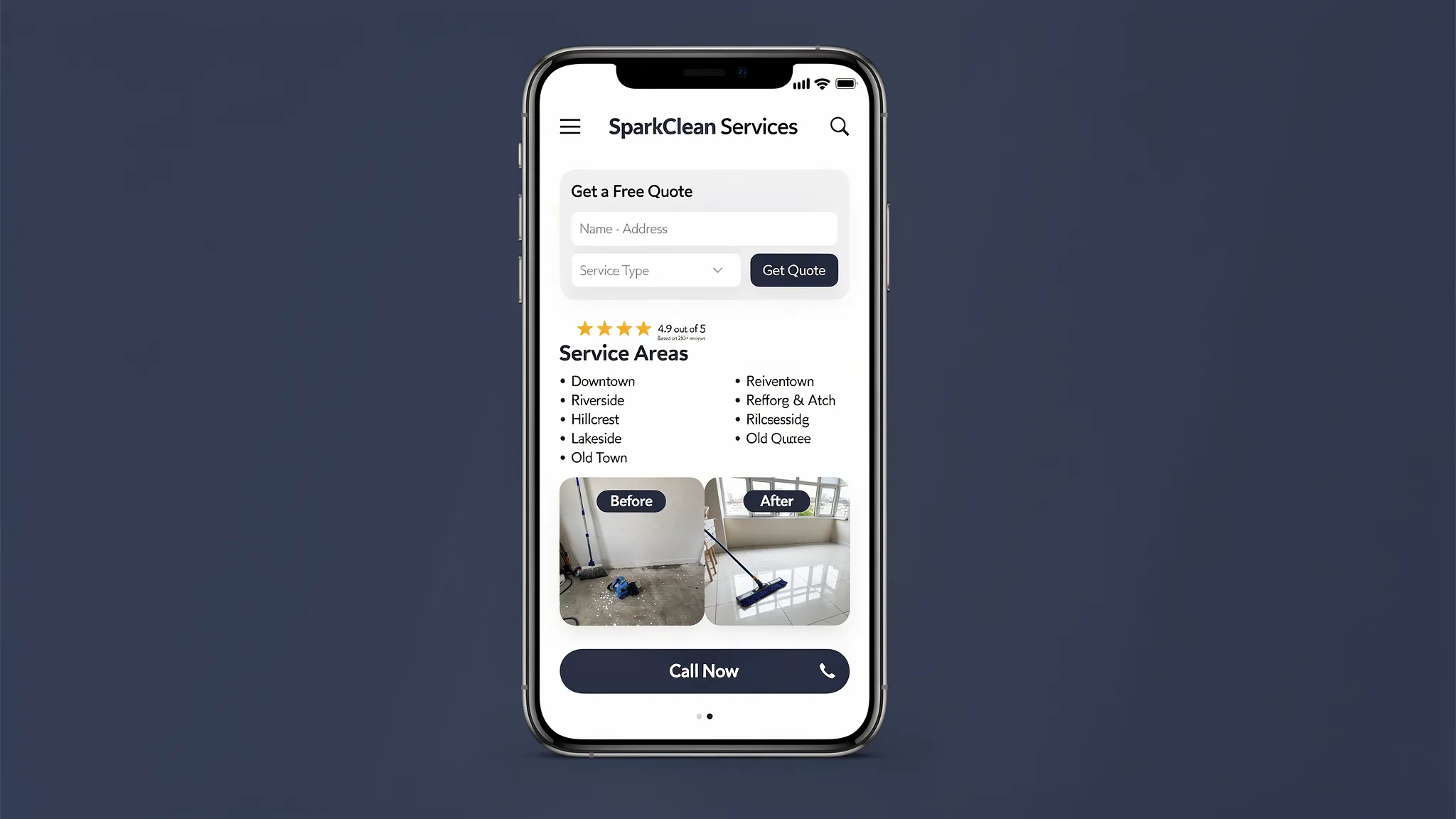
| Phone number is not sticky on mobile | People are on phones, they do not want to hunt | Add a click-to-call button that stays visible |
| No service area clarity | People are unsure if you serve them | List neighborhoods/zip codes (truthfully), add a service area section |
| Only one generic “Services” page | Google cannot match you to specific searches | Create focused pages (deep cleaning, move-out, office cleaning, etc.) |
| Slow pages, especially on mobile | Users bounce, Google notices | Compress images, clean up plugins, improve Core Web Vitals |
| Forms feel like a chore | People abandon | Short quote form, clear expectation (time to respond) |
| No proof (reviews, photos, guarantees) | Trust is the deciding factor | Add review widgets, before/after photos, insured/bonded info if true |
If your site is on WordPress, speed and clarity are usually fixable quickly without rebuilding everything. If you are unsure whether your site is helping or hurting, this page explains the overlap between design and rankings in a business-friendly way: SEO Web Design Strategies to Rank Higher.
Step 2: Win Google Maps with a Google Business Profile that looks “complete”
Your Google Business Profile (GBP) is often your best salesperson, because it shows up right when someone is ready to hire.
Focus on these GBP items first:
- Primary category: choose the most accurate primary category (do not get cute). Add relevant secondary categories if they truly match your services.
- Services: fill out your services list completely. Use real service names customers search.
- Service areas: set them realistically. Serving “everywhere” can backfire if you cannot actually cover it.
- Photos: real team, real work, real results. Update regularly.
- Business description: short, specific, and local. Mention what you do and where you do it.
- Q&A: seed common questions (parking, supplies, same-day, pets) and answer them.
Google publishes guidance on what is allowed and what can trigger issues like suspensions. Keep it clean and consistent with the rules in the Google Business Profile guidelines.
One quick GBP conversion upgrade most cleaning companies miss
Make sure your listing leads somewhere useful.
If your website homepage is not built for quotes, send GBP traffic to a dedicated “Get a Quote” or “Booking” page (even if it is simple). The point is fewer clicks, more leads.
Step 3: Build service pages that match how people search (and how Google ranks)
Cleaning companies often try to rank with one page that says:
“We offer residential and commercial cleaning.”
That is not enough.
People search by job type and situation, not by your business structure. Google needs clear pages that align with those searches.
A strong starting set usually looks like:
- House cleaning
- Deep cleaning
- Move-in/move-out cleaning
- Apartment cleaning
- Office/commercial cleaning (only if you truly want those leads)
- Post-construction cleaning (only if you truly offer it)
Each page should answer the real questions that block someone from calling:
- What is included?
- How pricing works (even if you give ranges or “based on size”)
- What areas you serve
- How fast you can schedule
- Proof (reviews, photos)
- Clear CTA (call or quote form)
Avoid “doorway” location pages
If you serve 20 neighborhoods, do not spin up 20 near-identical pages with only the city name swapped.
If you want location pages, do it the right way:
- Only create pages for areas you actually target
- Add real, unique content (common home types, parking realities, building access, local landmarks, service boundaries)
- Show local proof (reviews mentioning that area, photos from jobs there)
Step 4: Turn reviews into a system (not a one-time push)
For local service businesses, reviews are not just “nice.” They are a ranking signal and a trust signal.
BrightLocal’s annual local consumer research consistently shows that reviews influence purchase decisions for local services. Their Local Consumer Review Survey is worth skimming if you want to see how buyers think.
A simple review system that works for cleaning
Ask at the moment value is highest, right after the job, when the customer is happy.
Practical options:
- Text message with your Google review link
- Email follow-up with one direct link
- A small card/QR code (hand it over after a walkthrough)
Two rules:
- Do not offer incentives for reviews.
- Respond to reviews, including negative ones, calmly and professionally.
Google outlines what is and is not allowed in their reviews policy.
What to say when you respond (the lead-first version)
A good response does three things:
- Confirms the service (deep clean, move-out, recurring)
- Reinforces trust (insured, checklist-based, punctual)
- Mentions location naturally (Brooklyn, Queens, etc.)
Keep it human. You are writing for future customers, not for Google.
Step 5: Get your local “citations” consistent (so Google trusts your business info)
A citation is any place your business name, address, and phone number appear online.
For cleaning companies, inconsistent info is common, especially after:
- Moving offices
- Switching phone numbers
- Rebranding
- Using tracking numbers incorrectly
The goal is consistency, because Google uses this data to validate your business.
Here is a practical prioritization list:
| Citation type | Examples | Why it matters |
|---|---|---|
| Core platforms | Google Business Profile, Apple Business Connect | These feed major maps and assistants |
| Major directories | Yelp, Bing Places | Visibility plus trust signals |
| Local/community | Chamber of Commerce, neighborhood directories | Local relevance, sometimes links |
| Industry marketplaces (only if accurate) | Home services directories you actively use | Can drive leads, but keep info consistent |
If you want to improve visibility beyond Google, your Bing presence can also help in certain markets. This pairs well with Sleek’s guide: Local SEO tips for Bing.
Step 6: Earn local links that actually fit a cleaning business
Links are still a trust signal, but most cleaning companies do not need complicated link-building campaigns.
You need a few strong, relevant local links that make sense.
Good link sources for cleaning companies:
- Property managers you work with (vendor page)
- Local real estate offices (preferred vendors)
- Local nonprofits you support (sponsor page)
- Local chambers and business associations
- Testimonials to suppliers you actually use (they often publish them)
Skip shortcuts like buying links or joining spammy “SEO directory networks.” Those usually create long-term problems.
Step 7: Use AI to move faster (without the hype)
AI is useful in local SEO when it speeds up the boring parts, but you still make the decisions.
Here are practical ways cleaning companies (and agencies like Sleek Web Designs) can use AI responsibly:
- Find missed service keywords by comparing what customers ask for versus what your pages mention
- Improve page clarity by rewriting wordy sections into simple benefits and next steps
- Draft review responses faster, then edit them to sound like your business
- Analyze competitors to spot gaps (missing services, weak photos, bad calls to action)
The point is not to “let AI do your marketing.” The point is to ship improvements faster, then measure what produces calls.
Track what matters: leads, not vanity metrics
A cleaning company does not need 50 SEO reports. You need a few numbers that tie back to revenue.
Here is a simple tracking setup that works:
| Metric that matters | Where to track it | What it tells you |
|---|---|---|
| Calls from GBP | Google Business Profile performance | Map visibility turning into phone calls |
| Quote form submissions | GA4 events (or form backend) | Website is producing leads |
| Direction requests | GBP performance | Local intent is high, often a sign of strong map presence |
| Top converting pages | GA4 + Google Search Console | Which services and locations produce leads |
| Rankings by area | Local rank tracking (zip codes/neighborhoods) | Whether you are visible where you want jobs |
If you cannot answer “How many calls did Google Maps generate last month?” you are flying blind.
A realistic 30-60-90 day plan for cleaning company local SEO
You can do this fast, but you cannot do it sloppy.
Days 1 to 30 (stop the lead leaks): Fix the website conversion basics, set up tracking, clean up your Google Business Profile, and align your NAP (name, address, phone) everywhere.
Days 31 to 60 (build relevance): Publish or upgrade core service pages, add real photos, and start a consistent review request process.
Days 61 to 90 (build authority): Earn a handful of local links, continue review velocity, and refine pages based on what converts (calls and forms, not just clicks).
Results vary by competition and area, but this timeline is realistic for meaningful improvement if the work is focused.
When it makes sense to bring in help
If you are busy running crews and handling customers, local SEO often sits on the back burner until slow season hits.
It is usually time to bring in a pro when:
- You are not showing in Maps, even for your own brand name
- You show up but calls are inconsistent
- Competitors with worse service keep outranking you
- Your site gets traffic but few quote requests
- You do not have time to manage reviews, pages, and listings consistently
Sleek Web Designs focuses on exactly this type of work: turning websites into lead-generating systems through website optimization, local SEO, and AI-assisted analysis, without locking you into long-term contracts.
If you want a straightforward path forward, start here: Local SEO services. You will get clarity on what is broken, what to fix first, and what will actually drive more calls.