If your Google Maps rankings dropped, treat it like a lead problem first. Lower visibility in the Map Pack can quickly turn into fewer phone calls, fewer direction requests and fewer booked jobs. The right response is not to panic, rename your business listing or rebuild your whole website overnight. The right response is to find what changed, fix the highest-risk issues and rebuild the signals Google uses to trust your business locally.
For a local service business, Google Maps recovery is usually practical work: profile accuracy, service relevance, reviews, website clarity, local trust and conversion tracking. This plan walks through what to check first, what to fix next and when it makes sense to bring in help.
First, confirm the drop is real
Google Maps results are heavily local. A plumbing company may rank well from one neighborhood, poorly from another and differently again from a mobile phone a few miles away. Before you change anything, confirm whether rankings actually dropped across your real service area or whether you are seeing normal local variation.
Do not rely only on one search from your office or your phone. Check several searches that match how customers look for you, such as “emergency plumber near me,” “driving school Brooklyn” or “house cleaning service near me.” Look from the neighborhoods you serve, not just your business address.
Check leads, not just positions
Rankings matter because they affect revenue. If your Map Pack position fell but calls stayed steady, the business problem may not be urgent. If rankings fell and calls dropped at the same time, move faster.
| What to check | Where to look | What it tells you |
|---|---|---|
| Calls from your listing | Google Business Profile performance | Whether Maps visibility is still producing leads |
| Website clicks | Google Business Profile performance | Whether users are still moving from Maps to your site |
| Organic traffic | Google Search Console or analytics | Whether the website also lost visibility |
| Lead form submissions | Your website forms or CRM | Whether the drop is affecting actual inquiries |
| Direction requests | Google Business Profile performance | Whether nearby searchers still find your location useful |
A ranking drop without a lead drop may call for monitoring. A ranking drop with fewer calls needs a recovery plan.
Why Google Maps rankings drop
Google explains that local results are based mainly on relevance, distance and prominence in its guide to improving your local ranking on Google. That means a drop usually comes from one of three areas: Google is less confident your business matches the search, your location is less competitive for that search or other businesses look more trusted than yours.
Here are common causes small businesses should check before making bigger changes.
| Possible cause | What it looks like | Recovery priority |
|---|---|---|
| Business category changed | You stop showing for core services | High |
| Website page changed or removed | Rankings and organic traffic drop together | High |
| Competitors improved profiles | You slide down slowly over time | Medium |
| Reviews slowed down | Calls drop even when views remain | Medium |
| NAP inconsistencies | Google sees conflicting name, address or phone details | Medium |
| Profile guideline issue | Listing is restricted, suspended or filtered | High |
| Service area or address changed | Rankings shift by neighborhood | High |
| Google update or Maps volatility | Many businesses see movement at once | Monitor first |
The biggest mistake is treating every drop the same. A category problem needs a different fix than a weak website. A guideline problem needs a different fix than a competitor getting more reviews.
Google Maps rankings dropped? Run this 7-day triage
If your Google Maps rankings dropped, spend the first week diagnosing instead of making random edits. Too many changes at once make it harder to know what worked. Worse, aggressive profile edits can trigger additional review from Google.
Use the first week to build a clean picture.
| Time frame | What to do | Why it matters |
|---|---|---|
| Day 1 | Write down the searches, locations and rankings you care about | Creates a baseline before changes |
| Day 1 | Check calls, website clicks and form leads for the last 30 to 90 days | Confirms business impact |
| Day 2 | Review recent profile edits, website changes and address updates | Finds obvious causes |
| Day 3 | Compare your profile to the top 3 local competitors | Shows gaps in categories, reviews and content |
| Day 4 | Check your website for broken pages, slow loading or missing service pages | Maps rankings are connected to website trust |
| Day 5 | Review business name, address, phone, hours and categories | Fixes core local data problems |
| Days 6 to 7 | Make only the highest-confidence fixes | Avoids messy testing |
A clean triage process protects you from overreacting. It also helps you explain the issue clearly if you decide to hire a local SEO agency later.
Fix the Google Business Profile issues that block recovery
Your Google Business Profile is often the first place to look because it directly powers your visibility in Maps. Start with the basics that influence relevance and trust.
Your primary category should match your main service, not a broad industry label. A driving school should not use a generic education category if a more specific category exists. A cleaning company should not bury its main service behind a secondary category. Secondary categories can help, but the primary category carries weight.
Your business name should match your real-world name. Adding extra keywords can create short-term movement, but it can also violate Google’s Business Profile guidelines. If your listing gets filtered, suspended or manually corrected, recovery becomes harder.
Clean up the conversion details
Your profile should make it easy for a customer to call, visit your website or understand what you offer. Check your phone number, business hours, appointment link, service list, business description, photos and service areas. If you have seasonal hours or emergency availability, keep that information accurate.
For a more complete profile review, use a structured Google Business Profile optimization checklist instead of guessing. A checklist keeps the work focused on calls and local visibility, not cosmetic edits that do not move leads.
Repair the website signals connected to Maps
Google Maps is not separate from your website. Your website helps Google understand what you do, where you do it and whether customers can trust you. If your site is thin, slow or unclear, your profile has less support.
This is where many small businesses get stuck. They think they have a Google Maps problem, but the real issue is the website attached to the profile. A recent website redesign, deleted service page, changed URL or poorly set up redirect can affect both organic search and Maps performance.
Make service pages specific and useful
Each important service should have a clear page that explains what you offer, who it is for and where you provide it. A contractor should not rely on one generic “Services” page if they want to rank for roofing, siding and remodeling. A driving school should have pages that clearly describe lessons, road test preparation and the areas served.
The page linked from your Google Business Profile should also be mobile responsive and easy to act on. If someone lands on your site from Maps, they should see a phone number, service area, trust signals and a clear next step without hunting.
Check technical issues after any website change
WordPress websites can lose traffic after plugin updates, theme changes, accidental noindex settings or broken redirects. Custom website work can also create problems if page structure changes without an SEO plan. If rankings and website traffic both dropped, review common causes of sudden SEO loss before blaming Maps alone. This guide to SEO problems that can tank website traffic is a good place to start.
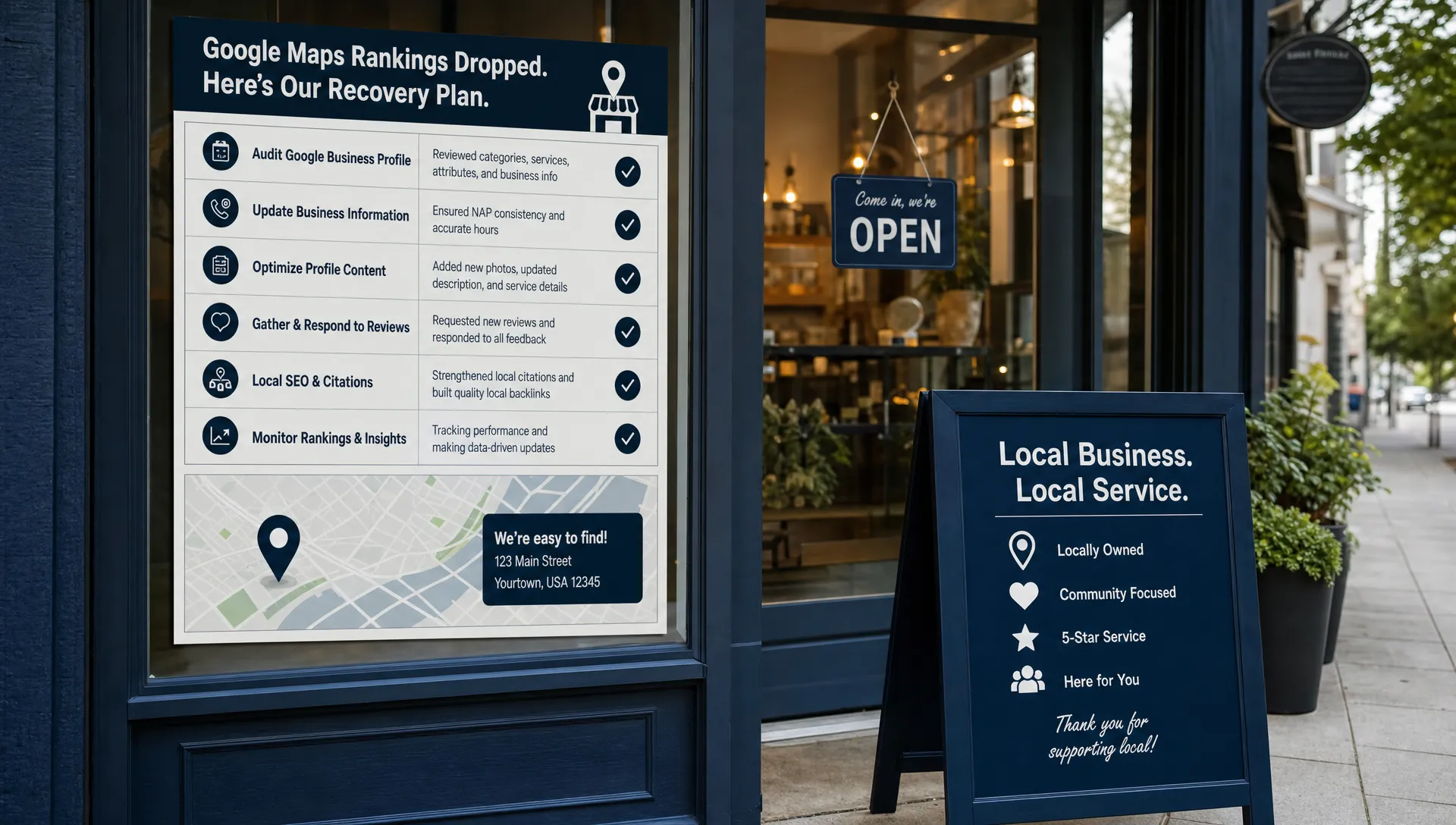
Rebuild trust with reviews and local prominence
If there is no obvious technical problem, your drop may be competitive. Another business may have earned more reviews, added better photos, improved its website or built stronger local mentions. Google calls this prominence, and it is one of the core local ranking concepts.
Start with reviews. Do not buy them, trade for them or pressure customers. Ask real customers after completed work, make the process simple and respond to reviews in a normal business tone. A steady review pattern helps both visibility and conversion because customers compare options quickly in the Map Pack.
Prominence also comes from the rest of the local web. Your business details should be consistent across important directories, local associations, social profiles and industry sites. Name, address, phone number and website should match. If you moved, changed phone numbers or rebranded, old citations can create confusion.
Local backlinks can also help, but they should come from real relationships. Sponsoring a neighborhood event, joining a local chamber, getting listed by a trade organization or being mentioned by a local publication is more useful than low-quality directory spam.
Watch competitors, but do not copy blindly
Competitor analysis is useful, but copying everything another business does is a bad plan. A competitor may rank because they are closer to the searcher, have an older business presence or have stronger brand recognition. You cannot copy location or history.
Look for practical gaps instead. Compare primary category, service descriptions, review volume, review quality, photos, website clarity and whether they have specific service pages. If three competitors ranking above you all have stronger pages for a service you barely mention, that is a clear fix.
Also check for spam. Some businesses rank with keyword-stuffed names, fake addresses or duplicate listings. You can suggest edits or report clear violations through Google, but do not make spam fighting your only strategy. Reporting competitors may help, but building a stronger profile and website is more reliable.
Use AI as a diagnostic tool, not a shortcut
AI can speed up Google Maps recovery when it is used to organize information, not replace judgment. It can review your website copy for unclear service language, compare your profile content against competitors and summarize patterns in customer reviews. It can also help identify missing service topics that customers repeatedly mention.
That does not mean you should publish a pile of AI-generated city pages or fake review responses. Low-quality content creates noise. For local SEO, clarity usually beats volume.
A practical AI-assisted review might answer questions like these:
- Are our top services clearly mentioned on the website and profile?
- Do reviews mention the services we want to rank for?
- Are competitors explaining their services better than we are?
- Does the website make it obvious where we work?
- Are calls to action visible on mobile?
The final decisions should still come from a human who understands the business, the service area and what a good lead looks like.
A 30-day recovery plan for local businesses
Once the first-week triage is done, shift into a simple 30-day recovery plan. The goal is not to touch everything. The goal is to fix the most likely causes, monitor results and strengthen the lead path.
| Week | Focus | Actions |
|---|---|---|
| Week 1 | Diagnosis | Confirm affected searches, review profile changes, compare leads and traffic |
| Week 2 | Profile cleanup | Correct category, services, hours, photos, business details and profile completeness |
| Week 3 | Website support | Improve service pages, local content, mobile calls to action and technical issues |
| Week 4 | Trust building | Request reviews, clean up citations, earn local mentions and monitor rankings by area |
Some changes can show movement quickly. Others take weeks because Google has to recrawl pages, process profile edits and reassess local signals. Track calls and form leads during the process so you know whether recovery is helping the business, not just the ranking report.
Mistakes to avoid after a Maps ranking drop
A drop in Google Maps can make business owners want to act fast. Acting fast is fine. Acting randomly is what causes problems.
Avoid these moves unless you have a clear reason:
- Changing your business name to add keywords
- Switching categories repeatedly in a short period
- Creating duplicate listings for the same business
- Deleting and rebuilding your Google Business Profile
- Publishing thin location pages for every nearby town
- Buying reviews or using fake accounts
- Redesigning the website without checking SEO impact
- Ignoring call tracking and only watching rankings
A good recovery plan is controlled. Make the right changes, document them and measure what happens.
When to bring in help
If your rankings dropped slightly for a few days, you may only need to monitor. Local results move. Google updates, competitor changes and searcher location can all create temporary shifts.
Bring in help when the drop affects calls, lasts more than a couple of weeks or follows a major change such as a redesign, relocation, phone number update, website migration or Google Business Profile suspension. You should also get help if you are not sure whether the problem is your profile, your website or your broader local SEO.
A good recovery partner should focus on leads and visibility, not vague marketing reports. You want someone who can explain what is broken, what needs to be fixed and how the work connects to calls, bookings or quote requests.
Frequently Asked Questions
How long does it take to recover Google Maps rankings? Some fixes can show improvement within days, especially if the issue was incorrect profile information. Website, review and prominence improvements usually take longer. A 30 to 90 day window is more realistic for measuring meaningful recovery.
Why did my Google Maps ranking drop but my website still ranks? Maps and organic results use overlapping but different signals. Your website may still rank because its pages are strong, while your Google Business Profile may have category, review, location or prominence issues.
Can changing my business category hurt my rankings? Yes. Your primary category is one of the most important relevance signals in your profile. Changing it to a less accurate category can reduce visibility for your main services.
Should I create more Google Business Profiles to rank in nearby towns? No, not unless you have legitimate staffed locations that qualify under Google’s guidelines. Duplicate or fake listings can create suspensions and make recovery harder.
Do reviews really help with Google Maps recovery? Reviews help with trust, conversion and local prominence. They are not the only factor, but a steady flow of real customer reviews can support recovery and increase calls from people comparing businesses in Maps.
Need help recovering visibility in Google Maps?
If your Google Maps rankings dropped and calls slowed down, you do not need a complicated marketing plan. You need a clear diagnosis, a cleaner Google Business Profile, a stronger website and a practical local SEO system built around leads.
Sleek Web Designs helps small service businesses improve local visibility, fix underperforming websites and turn search traffic into real inquiries. We use website optimization, local SEO and practical AI-assisted analysis to find what is not working and fix what matters. No long-term contracts, no vanity metrics, just a lead-first plan for getting found by the right local customers.