

Most real estate agents don’t have a “lead problem.” They have a visibility problem.
If you’re not showing up in the Google Map Pack for searches like “real estate agent near me,” “realtor in [city],” or “sell my house [neighborhood],” you’re handing leads to whoever is.
Local SEO fixes that by making Google confident about three things: you’re relevant, you’re nearby (or clearly serving the area), and you’re trusted. Google literally explains local rankings as relevance, distance, and prominence in its own documentation, and that should guide everything you do. (Source: Google’s local ranking factors)
This guide breaks down what actually moves the needle for real estate, with a focus on ranking, calls, and booked consultations, not “pretty marketing.”
What “ranking” means for real estate agents (and where the leads come from)
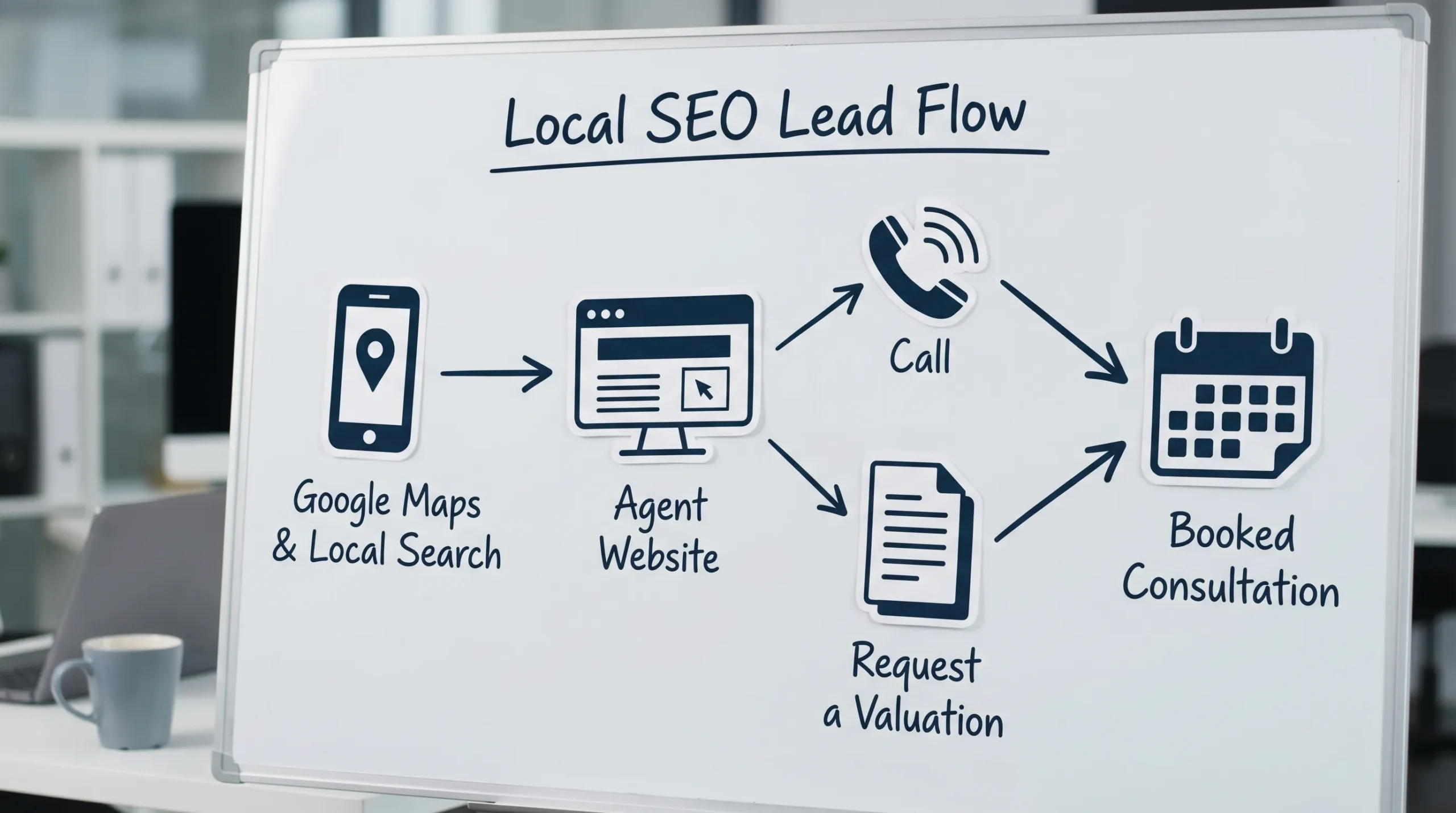
For agents, local SEO usually means two lead pipelines:
- Google Maps (Map Pack): High-intent searches. People want to talk to someone now.
- Local organic results: People researching neighborhoods, pricing, timelines, and agent options.
If you win both, you stop relying on referrals alone, and you stop paying for leads that are shared with 5 other agents.
The Local SEO stack that works for agents
Local SEO is not one trick. It is a system.
Here’s the stack, in the right order:
| Asset | What it impacts | What a lead-focused agent should care about |
|---|---|---|
| Google Business Profile | Map Pack visibility, calls, direction clicks, profile visits | Calls and “Website” clicks from your listing |
| Your website (conversion-first) | Organic rankings, trust, lead capture | Form submissions, booked consults, call clicks |
| Reviews | Map Pack rankings, conversion rate | Review volume, recency, quality, responses |
| Citations (directories) | Trust and consistency | Clean NAP, no duplicates |
| Local links | Authority and local relevance | Links from real local orgs, partners, press |
If your website is slow, confusing, or missing clear next steps, even a top ranking will underperform. Visibility only matters if it turns into leads.
Step 1: Set up your Google Business Profile the right way (without getting suspended)
Google Business Profile (GBP) is the biggest lever for real estate agents, and also the easiest place to make a mistake.
Choose the correct profile setup for your situation
Agents typically fall into one of these:
- You operate out of a staffed office that meets customers: You can show the address.
- You work from home or don’t meet clients at your address: You should set it as a service-area business and hide the address.
If you hide your address, you can still rank. You’re trading some “distance” signals for compliance and stability.
Categories and services: get specific
Your primary category should match what you are.
Then add supporting services that reflect what you want leads for, like buyer representation, seller representation, relocations, luxury, rentals, or investor services.
Don’t stuff keywords. Don’t add categories you can’t defend.
Use a description that earns clicks, not just rankings
A good GBP description:
- Says what you do
- Says where you do it
- Says what result you deliver
- Gives a clear next step
Example:
“Residential real estate agent serving Park Slope and surrounding Brooklyn neighborhoods. Helping sellers price and market homes for qualified offers, and helping buyers win without overpaying. Call or request a home value estimate.”
Photos and updates: treat GBP like a mini landing page
GBP is not just a listing, it is a conversion surface.
Post regularly (weekly is fine) and use photos that build trust:
- Professional headshot
- You at closings (client permission)
- Local neighborhood photos
- “Just sold” posts (with details you’re allowed to share)
Reviews: your fastest trust builder
A steady stream beats a one-time review burst.
What to do:
- Ask every closed client within 48 hours of the win.
- Send a direct review link.
- Respond to every review, even short ones.
Tip: You can guide clients with a simple prompt like, “Can you mention the neighborhood and what we helped you with (pricing, negotiation, first-time buyer guidance)?” Don’t script. Don’t incentivize.
Step 2: Build website pages that rank locally and convert
Most agent websites fail because they are built like an online brochure.
To generate leads, your site needs two things:
- Pages that match local search intent
- Clear conversion paths
The core pages real estate agents should have
At minimum:
- A strong homepage with one primary call-to-action (call or consult)
- A “Sell” page (seller intent)
- A “Buy” page (buyer intent)
- A neighborhood or area hub
- 1 page per core neighborhood you want to rank in (only if you can make them genuinely useful)
What a high-performing neighborhood page includes
A neighborhood page should not be 300 words of fluff.
Make it useful:
- Who the neighborhood is a fit for (families, commuters, investors)
- Typical housing stock and price ranges (keep it general, update regularly)
- Micro-areas and landmarks locals recognize
- Schools, transit, lifestyle
- A CTA that matches the page intent (tour request, buyer consult, valuation)
If you publish pages for 20 neighborhoods and they all read the same, you won’t rank and you’ll waste crawl budget.
Conversion matters more than “cool design”
If someone lands on your site from Google, they should immediately see:
- What you do
- Where you do it
- How to contact you
- Why they should trust you
Practical conversion elements that increase leads:
- A tap-to-call button on mobile
- A short “Request a valuation” form
- A “Book a consult” option
- Trust proof (reviews, transaction volume if you can claim it, years in business)
Step 3: On-page local SEO that actually helps you rank
You do not need to become an SEO expert. You just need to hit the basics consistently.
Title tags and headings
Your title tag should match what people search.
Examples:
- “Real Estate Agent in [City] | [Name]”
- “Sell Your Home in [Neighborhood] | [Brand]”
Then make sure your page:
- Has one clear H1
- Uses simple, scannable subheadings
- Answers the main questions people have
Internal linking (the easy win most agents ignore)
If you write a blog post like “Cost to sell a home in Brooklyn,” link it to your “Sell” page and the relevant neighborhood pages.
This helps Google understand what pages matter, and it moves authority through your site.
Add the right schema (don’t overdo it)
Schema can help Google read your business info cleanly.
Useful schema for agents:
- LocalBusiness or RealEstateAgent
- Organization
- FAQ schema on key pages (only when the content is actually on the page)
Step 4: Citations and NAP consistency (boring, but it prevents ranking problems)
Citations are your business listings across directories.
For agents, consistency can get messy because you may have:
- A brokerage address
- A team name
- An individual agent brand
Pick a standard and stick to it.
What matters:
- Same name format
- Same phone number
- Same website URL
- Same address rules (or hidden address if service-area)
If you have duplicates, wrong phone numbers, or old addresses floating around, you are literally feeding Google conflicting data.
Step 5: Local links that bring authority (and sometimes referrals)
Local links are one of the strongest signals of prominence.
The best links for agents come from:
- Local chambers of commerce
- Sponsorships (youth sports, neighborhood events)
- Local news and neighborhood blogs
- Partner pages (lenders, inspectors, attorneys)
- Nonprofit boards and community involvement
You can also earn links by publishing useful local resources. For example, if you work with buyers interested in alternative builds (like container conversions), a practical resource page could reference reputable suppliers where people can buy shipping containers online as part of the research process. It is not about selling containers, it is about creating genuinely useful local guidance that earns shares and links.
Step 6: Use AI for speed, not for shortcuts
AI helps when it reduces busywork, not when it replaces your credibility.
Good uses of AI for agents:
- Spotting missing GBP fields, weak categories, or inconsistent info
- Creating draft outlines for neighborhood pages (you still customize)
- Writing first drafts of GBP posts (you edit for accuracy and compliance)
- Summarizing FAQs you hear on calls into content ideas
Bad uses:
- Publishing AI-written neighborhood pages that could apply to any city
- Making up statistics, pricing trends, or market claims you cannot support
If your content sounds generic, it will not rank well and it will not convert.
What to track (so you know if local SEO is producing leads)
Rankings are not the goal. Leads are.
Track these monthly:
| KPI | Where to track it | Why it matters |
|---|---|---|
| Calls from Google Business Profile | GBP performance (calls) | Direct lead volume |
| Website clicks from GBP | GBP performance | Shows listing-to-site intent |
| Form submissions | Your website analytics | Real opportunities |
| Booked consults | Your CRM or calendar | The only number that really counts |
| Top queries and pages | Google Search Console | Tells you what to build more of |
If you are getting impressions but no clicks, your titles, descriptions, and GBP listing are not convincing.
If you are getting clicks but no leads, your website is the bottleneck.
A simple 30-day local SEO plan for agents
If you want a realistic plan you can execute, do this in the next 30 days:
Week 1: Fix the foundation
- Audit and complete your Google Business Profile
- Confirm NAP consistency across top directories
- Make sure your website has clear call and form paths on mobile
Week 2: Build the money pages
- Create or improve your Buy and Sell pages
- Add one strong neighborhood page for your primary target area
Week 3: Reviews and trust
- Start a review request process you can repeat weekly
- Add reviews to your website (with permission)
Week 4: Local authority
- Get one local link (sponsorship, chamber listing, partner)
- Publish one local resource post that answers a real client question
This is enough to start moving. Then you build consistency.
Frequently Asked Questions
How long does local SEO take for a real estate agent? Most agents see early movement in Google Business Profile activity within weeks, but consistent rankings and lead flow usually take a few months of steady work.
Can I have my own Google Business Profile if I work under a brokerage? Sometimes, yes, but it depends on how you operate and whether you meet clients at a staffed location. The setup needs to follow Google’s guidelines to avoid suspension.
Do I need to show my address to rank on Google Maps? No. Service-area businesses can rank with a hidden address, but you need stronger relevance and prominence signals (reviews, content, links, consistency).
Should I create a page for every neighborhood? Only if you can make each page genuinely useful and distinct. Ten great pages beat fifty thin pages.
Can I use AI to write my local SEO content? You can use AI to speed up drafts and research, but you still need to add real local insight, accurate details, and a clear call-to-action. Generic content rarely ranks or converts.
Want your website and local SEO to produce more real leads?
If you’re a real estate agent with a site that looks fine but does not generate calls, you don’t need more fluff. You need a tighter local SEO setup and a website built to convert.
Sleek Web Designs helps service-based businesses turn their websites into lead-generating systems through website optimization, local SEO, and AI-assisted analysis. No long-term contracts.
Get started with a focused plan at Sleek Web Designs or review our Local SEO services if you want help getting ranked and getting consistent leads.